
Lata Kinjang's Eco-Tourism Cooperative: A Community-Driven Venture
Authors
-
 Ummi Salwa Ahmad Bustamam
University Sains Islam Malaysia
-
Mohd Shahron Anuar Said
-
Zurita Mohd Saleh
Cooperative Institute of Malaysia
-
Nor Arma Abu Talib
Cooperative Institute of Malaysia
-
Siti Hafizah Ramli
Cooperative Institute of Malaysia
-
Amalina Ibrahim
Abstract
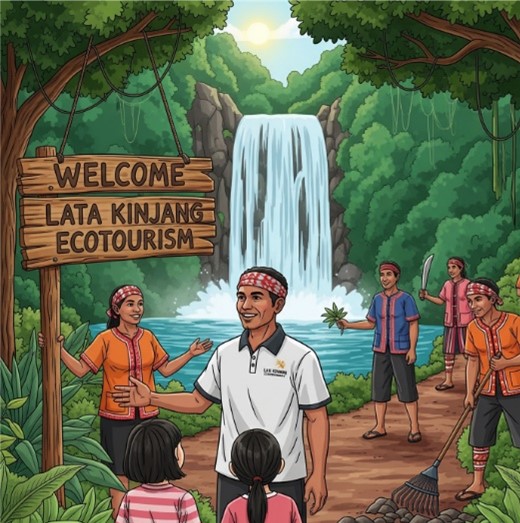
The Orang Asli, or indigenous populations, are groups characterized by distinct linguistic, epistemological and belief systems. Indigenous communities frequently share numerous characteristics with other marginalized societal segments, including insufficient political representation and engagement, economic disenfranchisement and impoverishment, limited access to social services and systemic discrimination. Furthermore, there exists a demographic challenge within the community, which often contributes to the neglect of their health and the fulfilment of fundamental necessities, such as adequate clothing and nutritious sustenance for the entire family. In Malaysia, these Indigenous populations are not forsaken and are instead administered by the Department of Orang Asli Development - Jabatan Kemajuan Orang Asli (JAKOA). Among the initiatives to empower this community is by encouraging them to form cooperative which will lead to socio-economic development. This paper highlights achievement by Koperasi Orang Asli Lata Kinjang Berhad (KOALKB), a cooperative established in July 2021 that began operating Taman Eko Rimba Lata Kinjang (TERLK), Tapah, Perak, Malaysia in July 2022. This research endeavour aims to elucidate the mechanisms through which KOALKB has emerged as one of the preeminent cooperatives representing the Orang Asli community in Malaysia. Using a case study method, this paper highlights TERLK, covering its eco-tourism business model. Furthermore, it addresses KOALKB's commitment to human capital development, its challenges and future plans for the sustainability of this Orang Asli cooperative. Ultimately, this paper will provide lessons that could be learned by other cooperatives especially the indigenous community.
Downloads
References
Alwiyasa, R. K. (2024). Social Capital and Economic Development of the Miduana Indigenous Village Community. 2(1), 1352–1363. https://doi.org/10.21009/isc-beam.012.89
Bansal, S., Sarker, T., Yadav, A., Garg, I., Gupta, M., & Sarvaiya, H. (2023). Indigenous communities and sustainable development: A review and research agenda. Global Business and Organizational Excellence. https://doi.org/10.1002/joe.22237
Burke, B. J. (2010). Cooperatives for “Fair Globalization”? Indigenous People, Cooperatives, and Corporate Social Responsibility in the Brazilian Amazon: Latin American Perspectives, 37(6), 30–52. https://doi.org/10.1177/0094582X10382098
De Gruyter, E., Gordon, J. A., Qureshi, I., Bhatt, B., & Mafico, N. (2024). Financing Indigenous entrepreneurs: A review and research agenda. Australian Journal of Management. https://doi.org/10.1177/03128962241270823
Durán-Díaz, P., Armenta-Ramírez, A., Kurjenoja, A. K., & Schumacher, M. (2020). Community Development through the Empowerment of Indigenous Women in Cuetzalan Del Progreso, Mexico. Land, 9(5), 163. https://doi.org/10.3390/LAND9050163
Echeverría, V., Fernandez Nieto, G., Jin, Y., Swiecki, Z., Zhao, L., Gašević, D., & Martínez-Maldonado, R. (2024). Human-AI Collaboration in Thematic Analysis using ChatGPT: A User Study and Design Recommendations. https://doi.org/10.1145/3613905.3650732
Emana, B. (2009). Cooperatives: a path to economic and social empowerment in Ethiopia. Research Papers in Economics. https://ideas.repec.org/p/ilo/ilowps/995017193202676.html
Giovannini, M. (2014). Indigenous Peoples and Self-Determined Development: the Case of Community Enterprises in Chiapas. http://eprints-phd.biblio.unitn.it/1228/
Hudson, S., Foley, R. J., & Cargo, M. (2022). Indigenous Social Enterprises and Health and Wellbeing: A Scoping Review and Conceptual Framework. International Journal of Environmental Research and Public Health, 19(21), 14478. https://doi.org/10.3390/ijerph192114478
Jolly, C. M. (1991). Can Cooperative Movements Be Successful in Traditional Societies? The Case of Southern Senegal. 6, 1–11. https://doi.org/10.22004/AG.ECON.46255
Kurti, L., Hudson, S., McKenzie, R., Milward, K., & Ventura, P. (2014). Enabling prosperity: success factors in Indigenous economic development. https://apo.org.au/node/52154
Luturmas, A. J., Wardhani, L. T. A. L., & Sukirno, S. (2024). Strengthening Indigenous Governance Structures based on Local Wisdom in Protecting the Territorial Rights of Indigenous Peoples. Journal of World Science. https://doi.org/10.58344/jws.v3i7.684
Maclean, K., Rist, P., Rassip, W., & Prudames, N. (2024). A practical tool to enable Indigenous enterprise planning and development grounded in culture. Sustainability Science. https://doi.org/10.1007/s11625-023-01459-1
Merriam, S. B. (2009). Qualitative Research: A Guide to Design and Implementation (The Jossey Bass Higher and Adult Education Series) (Volume 2). E-Published.
Middleton, B. R., & Kusel, J. (2007). Northwest Economic Adjustment Initiative Assessment: Lessons Learned for American Indian Community and Economic Development. Economic Development Quarterly, 21(2), 165–178. https://doi.org/10.1177/0891242406298136
Muhaimin, H., Herachwati, N., Hadi, C., Suhariadi, M. F., & Mudzakkir, M. F. (2024). Keramat Market as a Catalyst for Community Empowerment: Integrating Cultural Preservation, Skill Development, and Sustainability in Warugunung Village, Indonesia. International Journal For Multidisciplinary Research, 6(6). https://doi.org/10.36948/ijfmr.2024.v06i06.31192
Murray, A., & Scuotto, V. (2016). The Business Model Canvas. Symphonya. Emerging Issues in Management, (3), 94–109. https://doi.org/10.4468/2015.3.13murray.scuotto
Naeem, M., Smith, T., & Thomas, L. (2025). Thematic Analysis and Artificial Intelligence: A Step-by-Step Process for Using ChatGPT in Thematic Analysis. International Journal of Qualitative Methods, 24, 16094069251333886.
Ningsih, R., Wijaya, F., & Herlinawati, E. (2023). Analysis of business development using a business model canvas approach. Journal of Management Science (JMAS), 6(1), 117-124. https://doi.org/10.35335/jmas.v6i1.208
Nguyen-Trung, K. (2025). ChatGPT in thematic analysis: Can AI become a research assistant in qualitative research? Quality & Quantity. https://doi.org/10.1007/s11135-025-02165-z
Noble, B. F., & Fidler, C. (2011). Advancing Indigenous Community - Corporate Agreements: Lessons from Practice in the Canadian Mining Sector. Oil, Gas & Energy Law Journal, 9(4). https://www.ogel.org/article.asp?key=3143
Rahma, S. (2024). Pemberdayaan perempuan melalui koperasi. Harakat An-Nisa, 7(2), 73–82. https://doi.org/10.30631/72.73-82
Sengupta, U., & Sengupta, U. (2015). Indigenous Cooperatives in Canada: The Complex Relationship Between Cooperatives, Community Economic Development, Colonization, and Culture. Social Science Research Network. https://papers.ssrn.com/sol3/papers.cfm?abstract_id=2639146
Setiawan, W., & Azizah, N. (2023). “Indigenous” Cooperatives Supporting SDGs Development in Indigenous Communities: a study of social and communication (Case: The Consumer Cooperative of Warga Sauyunan, Kampung Naga, Regency of Tasikmalaya, West Java, Indonesia). International Journal of Ethno-Sciences and Education Research, 3(2), 70–76. https://doi.org/10.46336/ijeer.v3i2.427
Soni, A., Shaikh, Z. H., Irfan, M., & Bijja, V. (2024). Indigenous Empowerment as a Catalyst for Sustainable Development. Advances in Finance, Accounting, and Economics Book Series, 253–274. https://doi.org/10.4018/979-8-3693-7924-0.ch012
Vázquez-Maguirre, M. (2020). Building Sustainable Rural Communities through Indigenous Social Enterprises: A Humanistic Approach. Sustainability, 12(22), 9643. https://doi.org/10.3390/SU12229643
Yan, L., Echeverria, V., Fernandez Nieto, G., Jin, Y., Swiecki, Z., Zhao, L., Gašević, D., & Martinez-Maldonado, R. (2023). Human-AI Collaboration in Thematic Analysis using ChatGPT: A User Study and Design Recommendations. arXiv.Org, abs/2311.03999. https://doi.org/10.48550/arxiv.2311.03999
Yin, R. K. (2014). Case study research: Design and methods (applied social research methods).
Published
How to Cite
Conference Proceedings Volume
Section
License
Copyright (c) 2025 Proceeding of the Excellent Campus and Technology Conference

This work is licensed under a Creative Commons Attribution-ShareAlike 4.0 International License.





