
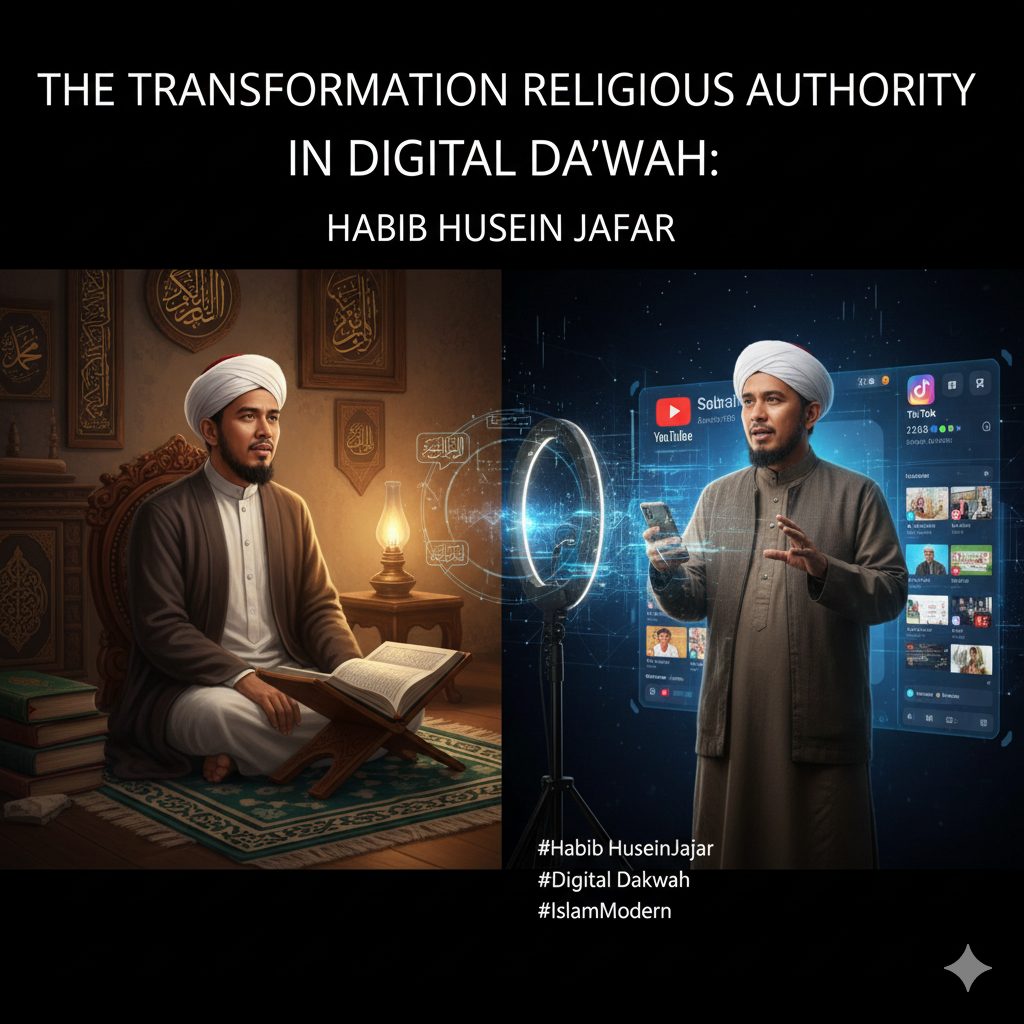
The Transformation of Religious Authority in Digital Da'wah Habib Husein Ja'far
Authors
-
 Abdulloh Hanif
STAI Al-Fithrah Surabaya, Indonesia
Abstract
The development of digital technology has changed the way Muslims in Indoesia express their religion, while giving rise to new forms of religious authority that are more fluid and flexible. This study examines how Habib Husein Ja'far built a new religious authority through the Jeda Nulis YouTube channel. The main problem raised is how the form of religious authority is built in the digital world and what is the role of Habib Ja'far in the process. This study uses content analysis methods and performative theoretical approaches as well as digital communication concepts to read the da'wah strategies used. The results of the study show that digital authority does not only depend on formal social or scientific status, but also on technical and communicative adaptability. The Jeda Nulis channel combines education and entertainment, with relaxed and popular language, so that it effectively reaches young audiences and forms relevant religious authorities in the digital age.
Downloads
References
Aboelnagah, H. (2022). Digital Narratives of Hajj as Literature in Motion: An Analytical Study of Contemporary Travelogues in Live Streaming and Vlogs. Proceedings - 2022 5th International Conference of Women in Data Science at Prince Sultan University, WiDS-PSU 2022. https://doi.org/10.1109/WiDS-PSU54548.2022.00034
Akgül, M. (2017). Dijitalleşme ve din. Marife Dini Araştırmalar Dergisi, 17(2).
Azizah, N. (2022). THE RATIONAL ACTION OF ELITE: MITIGATION THE COVID-19 AND COMMUNITY RESISTANCE IN PESANTREN SALAFIYAH SYAFI’IYAH SITUBONDO. Analisa: Journal of Social Science and Religion, 7(2). https://doi.org/10.18784/analisa.v7i2.1657
Bergengruen, V. (2022). How Ukraine is crowdsourcing digital evidence of war crimes. TIME Magazine, 199(17).
Brumen, M., Duh, M., Herzog, J., & Zupančič, T. (2023). The Scope, Inclusion, and Experiences of International Teachers with a Migrant Background in Slovenian Schools. In Perspectives on Teacher Education and Development. https://doi.org/10.18690/um.pef.1.2023.9
Cimoli, A. C. (2023). All Things Sacred. An Experience in Diversity and Active Citizenship at a Contemporary Art Museum. Lecture Notes in Networks and Systems, 631 LNNS. https://doi.org/10.1007/978-3-031-25906-7_50
Clover, D. E., Sanford, K., Bell, L., & Johnson, K. (2016). Adult education, Museums and Art Galleries: Animating Social, Cultural and Institutional Change. In Sense Publishers (Vol. 20).
Dudin, P. N., Beshentsev, A. N., & Bazarov, K. Y. (2023). Traditional Institutions of Public Authority in Mongol-Inhabited Lands of Imperial and Republican China, 1900s–1920s: Spatial Localization and Visualization. Oriental Studies, 16(2). https://doi.org/10.22162/2619-0990-2023-66-2-293-312
Fogarassy, É., & Demongeot, F. (2022). The digital revolution and religious fact in the context of lockdowns linked to the coronavirus. In The Covid-19 Crisis: From a Question of an Epidemic to a Societal Questioning (Vol. 4). https://doi.org/10.1002/9781394163755.ch4
George, R. (2024). Pikala Bikes, Marrakesh, Morocco: A social entrepreneurship company. In Cases on Entrepreneurship and Diversity. https://doi.org/10.4337/9781803923857.00020
Guimarães Junior, J. C., Campos, R. L. G. de, Campos, A. G. de, Peres, M. A. dos S., Neves, H. G., Nascimento, I. J. B. M. F. do, Oliveira, H. de, Souza, E. D., & Ferreira, A. P. (2024). NATIVOS E MIGRANTES DIGITAIS. RCMOS - Revista Científica Multidisciplinar O Saber, 1(1). https://doi.org/10.51473/ed.al.v3i1.592
Kandemir, S., & Toprak, H. K. (2023). The Religious Reference Setting of Youth and Digital Media. Ankara Universitesi Ilahiyat Fakultesi Dergisi, 64(2). https://doi.org/10.33227/auifd.1320301
Khamis, S. (2024). The Paradoxes of Modern Islamic Discourses and Socio-Religious Transformation in the Digital Age. Religions, 15(2). https://doi.org/10.3390/rel15020207
Kilonzo, S. M., Chitando, E., & Tarusarira, J. (2023). The Palgrave Handbook of Religion, Peacebuilding, and Development in Africa. In The Palgrave Handbook of Religion, Peacebuilding, and Development in Africa. https://doi.org/10.1007/978-3-031-36829-5
KOCAOĞLU, A., ÇAYIR, A., & GÜNER YILDIZ, N. (2023). A Review of Research on the Education of Migrant Students with Special Needs. Ankara Üniversitesi Eğitim Bilimleri Fakültesi Özel Eğitim Dergisi, 24(4). https://doi.org/10.21565/ozelegitimdergisi.1223932
Kołodziejska, M. (2018). Online Catholic communities: Community, authority, and religious individualisation. In Online Catholic Communities: Community, Authority, and Religious Individualisation. https://doi.org/10.4324/9781315163376
Kołodziejska, M., & Neumaier, A. (2017). Between individualisation and tradition: transforming religious authority on German and Polish Christian online discussion forums. Religion, 47(2). https://doi.org/10.1080/0048721X.2016.1219882
Lewis, J., & Caldwell, B. J. (2016). Guidelines for Preparation of Public School Financial Statements. Saica, 15(1).
Lord, R. G., Brown, D. J., Freiberg, S. J., Braun, S., Peus, C., Weisweiler, S., Frey, D., Pearce, C. L., Thomas, T., Jr, J. R. S. W. S., Dienhart, J. W., Ashmos, D. P., Duchon, D., Phipps, K. A., Pawar, B. S., Weaver, G. R., Agle, B., Evers, F. T., Warren, E., … Warschauer, M. (2005). Work closes. The Leadership Quarterly, 21(1).
Mochel, L. (2023a). Ministérios no WhatsApp: gênero, sensorialidades e transformações ético-políticas no cotidiano de mulheres evangélicas. Sexualidad, Salud y Sociedad (Rio de Janeiro), 39. https://doi.org/10.1590/1984-6487.sess.2023.39.e22301.a.pt
Mochel, L. (2023b). Ministries on WhatsApp: gender, sensorialities and ethical-political transformations in the everyday life of evangelical women. Sexualidad, Salud y Sociedad (Rio de Janeiro), 39. https://doi.org/10.1590/1984-6487.sess.2023.39.e22301.a.en
Mundiri, A., & Nawiro, I. (2019). ORTODOKSI DAN HETERODOKSI NILAI-NILAI DI PESANTREN: STUDI KASUS PADA PERUBAHAN PERILAKU SANTRI DI ERA TEKNOLOGI DIGITAL. Jurnal Tatsqif, 17(1). https://doi.org/10.20414/jtq.v17i1.527
Mustofa, M. Y., Mas’ud, A., & Elizabeth, M. Z. (2023). Hybrid Pesantren in Indonesia; Analyzing the Transformation of Islamic Religious Education in the Digital Age. Al-Tadzkiyyah: Jurnal Pendidikan Islam, 14(1).
Neumaier, A. (2016). Comment on Possamai, Turner, Roose, Dagistanli and Voyce/4.: About authority, (de-)territorialisation and their intersections. In Sociologica (Vol. 10, Issue 1). https://doi.org/10.2383/83886
Radde-Antweiler, K. (2018). Religion as communicative figurations – analyzing religion in times of deep mediatization. In Mediatized Religion in Asia: Studies on Digital Media and Religion. https://doi.org/10.4324/9781315170275-18
Rahman, A. (2023). Migrating Human Capital: A Case Study of Indian Migrants in the GCC Countries. In Political Economy of the Middle East. https://doi.org/10.1007/978-981-19-8072-5_4
Rohmatulloh, D. M., Achfandhy, M. I., & Patmaningsih, A. (2023). THE ENCOUNTER OF DA’WAH DIGITALIZATION WITH URBAN MUSLIM CULTURE. Akademika : Jurnal Pemikiran Islam, 28(1). https://doi.org/10.32332/akademika.v28i1.7751
Sharp, H., & Parkes, R. (2023). National Identity in the History Curriculum in Australia: Educating for Citizenship. In Negotiating Ethnic Diversity and National Identity in History Education: International and Comparative Perspectives. https://doi.org/10.1007/978-3-031-12535-5_8
Ummah, A. H. (2021). New Media and Women’s Da’wah Movement in the New Normal Post Covid-19 Era. HIKMATUNA: Journal for Integrative Islamic Studies, 7(2). https://doi.org/10.28918/hikmatuna.v7i2.3757
Urban, H. B. (2022). Dark Webs: Tantra, Black Magic, and Cyberspace. International Journal of Hindu Studies, 26(2). https://doi.org/10.1007/s11407-022-09318-x
Published
How to Cite
Conference Proceedings Volume
Section
License
Copyright (c) 2025 Proceeding of the Excellent Campus and Technology Conference

This work is licensed under a Creative Commons Attribution-ShareAlike 4.0 International License.





