
The Human Pillar in the Digital Era: Customer Trust in Sharia Mobile Banking for Financial Inclusion and Sustainable Growth (A Study of BSI KCP Pekanbaru Panam)
Authors
-
 Shella Monica
Universitas Muhammadiyah Riau, Indonesia
-
Rika Septianingsih
-
Wahyi Busyro
Keywords:
Security Perception, Risk Perception, Customer Trust, Sharia Mobile Banking, Digital Inclusion, Financial SustainabilityAbstract
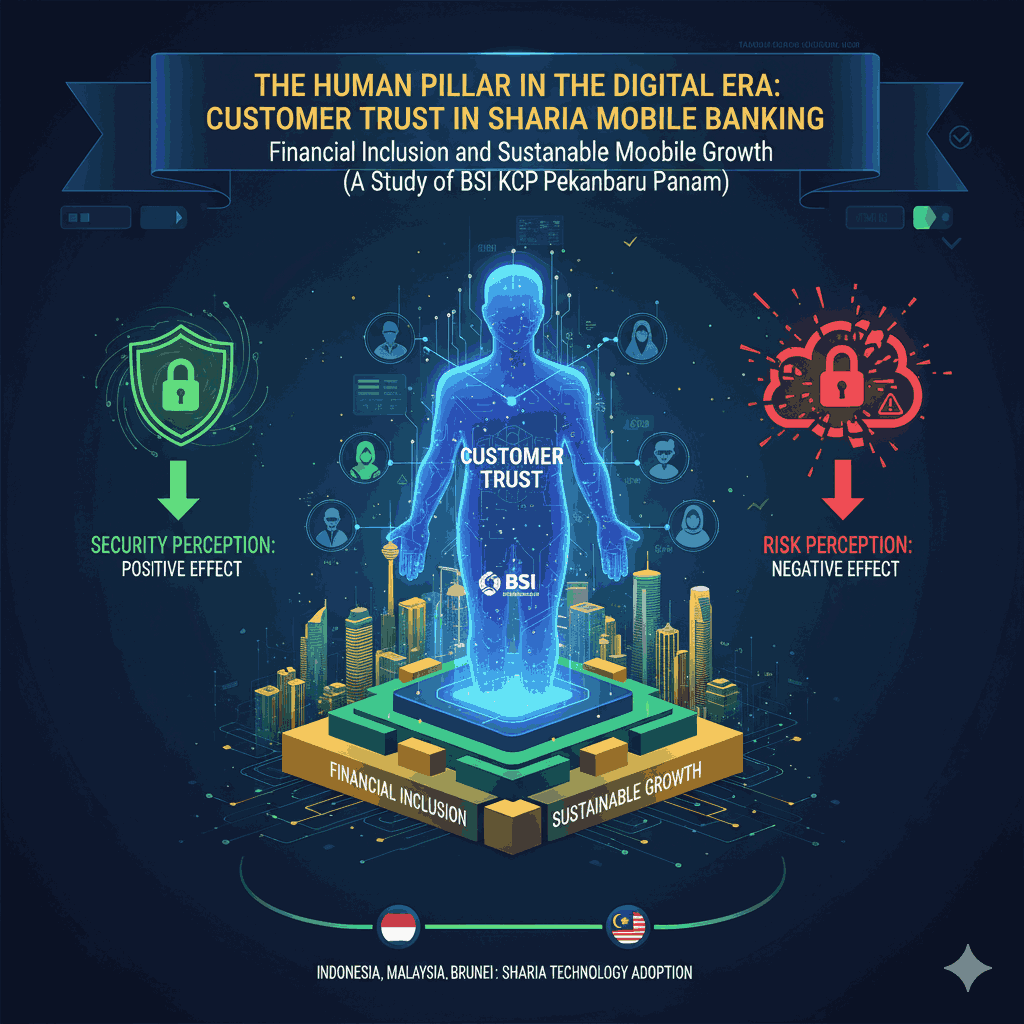
The background of this research is driven by the accelerated adoption of Bank Syariah Indonesia's (BSI) mobile banking services, a tangible manifestation of Technology integration within the Islamic financial ecosystem. However, this surge in usage is overshadowed by critical issues concerning cybersecurity and transaction risks, which can erode Customer Trust (Humanity). The stability of this trust is fundamental to ensuring the Sustainability of digital financial literacy and inclusion growth, not only in Indonesia but also across the Southeast Asian region. This study aims to analyze the partial and simultaneous influence of Security Perception and Risk Perception on Customer Trust at BSI KCP Pekanbaru Panam. Employing a quantitative research method with descriptive and associative approaches, data was collected via surveys and analyzed using multiple linear regression. The findings indicate that Security Perception has a positive and significant effect on Customer Trust, while Risk Perception has a negative and significant effect. Simultaneously, both variables show a significant influence on Customer Trust. The main conclusion is that establishing robust digital security defenses and implementing transparent risk mitigation strategies are prerequisites for maintaining trust. Stable customer trust, in turn, serves as the central pillar guaranteeing the ethical, inclusive, and sustainable adoption of Sharia technology among conference participant nations (Indonesia, Malaysia, Brunei) that predominantly operate Islamic financial systems.
Downloads
References
Abdalla, A. M., & Adam, S. (2022). The impact of digital sharia banking on financial inclusion: Evidence from Southeast Asia. Journal of Islamic Monetary Economics and Finance, 8(2), 245-268.
Abdou, H. A., English, J., & Adewunmi, P. (2021). Risk perception and consumer trust in digital banking: A comparative study. International Journal of Bank Marketing, 39(4), 567-589.
Abu-Alhaija, A. S., Yusof, R. N., Hasnan, N., & Jaharuddin, N. S. (2018). Determinants of customer trust in Islamic banks: A systematic review. International Journal of Academic Research in Business and Social Sciences, 8(11), 1234-1250.
Adnan, S. M. (2020). Sharia banking and the digital challenge: Security and ethics. Jakarta: Rajawali Press.
Ahmad, A., & Al-Qudah, A. A. (2023). The role of cybersecurity in building customer loyalty in Islamic fintech services. Journal of Financial Crime, 30(1), 112-130.
Ajzen, I. (1991). The theory of planned behavior. Organizational Behavior and Human Decision Processes, 50(2), 179-211.
Al-Adwan, A. S., & Al-Horani, A. (2022). Mobile banking adoption in the post-pandemic era: The integration of trust and risk. Journal of Science and Technology Policy Management, 13(3), 450-478.
Ali, M., & Rehman, S. A. (2021). Factors affecting customer trust in Islamic mobile banking: An empirical study from Pakistan. Journal of Islamic Marketing, 12(6), 1120-1142.
Alnemer, H. A. (2022). Determinants of digital banking adoption in the Kingdom of Saudi Arabia: A technology-trust-risk model. Frontiers in Psychology, 13, 895-912.
Amin, H. (2016). Consumer behavior of Islamic mobile banking in Malaysia. Journal of Islamic Marketing, 7(3), 275-288.
Antwi, S. (2021). Financial inclusion and sustainable development: The role of digital financial services. Sustainable Development, 29(3), 512-525.
Bahl, S. (2012). The role of technology in banking sector. International Journal of Business and Management, 4(2), 123-134.
Basyar, A. M. (2022). Analisis Mitigasi Risiko pada Mobile Banking Bank Syariah Indonesia. Pekanbaru: Universitas Islam Negeri Sultan Syarif Kasim Riau.
Belanche, D., Casaló, L. V., & Flavián, C. (2019). Artificial Intelligence in FinTech: Understanding customer trust and adoption. Service Business, 13(4), 811-833.
Boulahbel, A. (2021). Sharia compliance and digital transformation in Islamic banks. Global Review of Islamic Economics and Business, 9(1), 45-58.
Chawla, D., & Joshi, H. (2019). Consumer attitude and intention to adopt mobile banking in India – An empirical study. International Journal of Bank Marketing, 37(7), 1590-1618.
Chen, Y., & Li, S. (2021). The impact of cybersecurity on financial stability: A global perspective. Journal of Banking and Finance, 124, 106-125.
Crosby, L. A., Evans, K. R., & Cowles, D. (1990). Relationship quality in services selling: An interpersonal influence perspective. Journal of Marketing, 54(3), 68-81.
Darmansyah, D., & Bayu, A. (2020). Fintech and Islamic Finance: Digitalization of Sharia Financial Services. London: Routledge.
Demirguc-Kunt, A., Klapper, L., Singer, D., & Ansar, S. (2022). The Global Findex Database 2021: Financial Inclusion, Digital Payments, and Resilience in the Age of COVID-19. Washington, DC: World Bank.
Dorfman, M. S. (2018). Introduction to Risk Management and Insurance. New York: Pearson.
Fadhli, M. (2021). Implementasi Keamanan Data Nasabah pada Aplikasi BSI Mobile. Pekanbaru: Laporan Riset Internal BSI KCP Panam.
Ferdinand, A. (2014). Metode Penelitian Manajemen. Semarang: Badan Penerbit Universitas Diponegoro.
Ganesan, S. (1994). Determinants of long-term orientation in buyer-seller relationships. Journal of Marketing, 58(2), 1-19.
Gefen, D., Karahanna, E., & Straub, D. W. (2003). Trust and TAM in online shopping: An integrated model. MIS Quarterly, 27(1), 51-90.
Hair, J. F., Black, W. C., Babin, B. J., & Anderson, R. E. (2019). Multivariate Data Analysis (8th ed.). Hampshire: Cengage Learning.
Hanafizadeh, P., & Khedmatgozar, H. R. (2012). The role of awareness in reducing the distance between Internet banking adoption and its potential utilization. Government Information Quarterly, 29(1), 103-109.
Haro, A. S. (2020). Factors influencing customer trust in Islamic mobile banking. Journal of Islamic Economics and Finance, 6(2), 89-104.
Iman, N. (2020). The rise of Islamic fintech in Indonesia: Challenges and opportunities. FinTech Law and Regulation, 2(3), 210-225.
Iqbal, M., & Molyneux, P. (2016). Thirty Years of Islamic Banking: History, Performance and Prospects. New York: Palgrave Macmillan.
Iswanto, B. (2021). Digitalisasi Perbankan Syariah di Indonesia. Surabaya: Pustaka Media.
Kamarulzaman, Y., & Madun, A. (2013). Marketing Islamic banking products: Islamic perspective. Business Strategy Series, 14(2), 60-66.
Kashif, M., Wanat, T., & Syam, H. (2018). Customer trust and loyalty in Islamic banking. International Journal of Emerging Markets, 13(5), 1123-1140.
Kettell, B. (2011). Introduction to Islamic Banking and Finance. West Sussex: Wiley.
Khan, M. M., & Bhatti, M. I. (2008). Development in Islamic banking: A theoretical and empirical survey. International Journal of Social Economics, 35(10), 746-769.
Kurniawan, H. (2022). Persepsi Keamanan dan Risiko dalam Transaksi Digital. Yogyakarta: Andi Offset.
Laukkanen, T. (2016). Consumer adoption versus rejection of mobile banking. Journal of Business Research, 69(10), 4532-4539.
Mayer, R. C., Davis, J. H., & Schoorman, F. D. (1995). An integrative model of organizational trust. Academy of Management Review, 20(3), 709-734.
McKnight, D. H., Choudhury, V., & Kacmar, C. (2002). Developing and validating trust measures for e-commerce: An integrative typology. Information Systems Research, 13(3), 334-359.
Morgan, R. M., & Hunt, S. D. (1994). The commitment-trust theory of relationship marketing. Journal of Marketing, 58(3), 20-38.
Muneeza, A., & Mustapha, Z. (2021). Sharia-compliant fintech: The role of trust in sustainable finance. Journal of Islamic Finance, 10(1), 77-88.
Nasution, C. (2022). Sistem Keamanan Perbankan Digital dan Perlindungan Nasabah. Medan: USU Press.
Ofori, K. S., Boateng, H., & Wu, L. (2017). Determinants of online banking adoption: The role of trust and security. Journal of Internet Commerce, 16(4), 341-365.
Pavlou, P. A. (2003). Consumer acceptance of electronic commerce: Integrating trust and risk with the technology acceptance model. International Journal of Electronic Commerce, 7(3), 101-134.
Pikkarainen, T., Pikkarainen, K., Karjaluoto, H., & Pahnila, S. (2004). Consumer acceptance of online banking: An extension of the technology acceptance model. Internet Research, 14(3), 224-235.
Pohan, A. (2021). Pilar Keberlanjutan Perbankan Syariah di Era Disrupsi. Jakarta: Gramedia Pustaka Utama.
Putra, P., & Lestari, D. (2020). Financial inclusion through digital sharia banking in Indonesia. Journal of Islamic Financial Studies, 6(1), 12-25.
Ramkumar, B., & Cooper, M. C. (2018). Impact of service quality on customer trust and loyalty in mobile banking. Service Industries Journal, 38(5), 234-256.
Raza, S. A., Umer, A., & Shah, N. (2017). New product adoption and post-purchase behavior in Islamic banking. Journal of Islamic Marketing, 8(3), 430-450.
Riffai, M. M., Grant, K., & Edgar, D. (2012). Big data in banking: A review of security and trust. Journal of Financial Services Marketing, 17(3), 190-205.
Sadi, M. A. (2023). Hukum Perbankan Syariah dan Keamanan Transaksi. Jakarta: Kencana.
Setiawan, B. (2019). Metodologi Penelitian Kuantitatif untuk Perbankan. Malang: UB Press.
Statista. (2023). Digital Banking Penetration in Southeast Asia 2020-2025. Retrieved from https://www.statista.com.
Sudarsono, H. (2020). Bank dan Lembaga Keuangan Syariah: Deskripsi dan Ilustrasi. Yogyakarta: Ekonisia.
Sugiyono. (2018). Metode Penelitian Kuantitatif, Kualitatif, dan R&D. Bandung: Alfabeta.
Sujati, H. (2021). Analisis Regresi Linier Berganda dalam Riset Bisnis. Bandung: Rosda Karya.
Tan, M., & Teo, T. S. (2000). Factors influencing the adoption of Internet banking. Journal of the Association for Information Systems, 1(1), 1-42.
Tarmidi, M., & Sitorus, T. (2022). Risk management and compliance in Sharia digital banking. Global Journal of Business Research, 16(2), 115-128.
Vayis, A., & Sahin, A. (2021). The effect of perceived security on digital banking trust: A moderation of age. Journal of Financial Services, 22(4), 88-102.
Wahyuni, S. (2022). Sustainability in Islamic Finance: A New Paradigm. Singapore: Springer Nature.
Yousafzai, S. Y., Pallister, J. G., & Foxall, G. R. (2003). A proposed model of e-trust for electronic banking. Technovation, 23(11), 847-860.
Yuan, S., Liu, Y., Yao, R., & Liu, J. (2016). An investigation of users’ continuance intention towards mobile banking in China. Information Development, 32(1), 20-34.
Zhou, T. (2012). Examining mobile banking user adoption from the perspectives of trust and flow experience. Information Technology and Management, 13(1), 27-37.
Published
How to Cite
Conference Proceedings Volume
Section
License
Copyright (c) 2025 Proceeding of the Excellent Campus and Technology Conference

This work is licensed under a Creative Commons Attribution-ShareAlike 4.0 International License.





