
Strengthening Fishermen's Economic Sustainability Through the Integration of Sharia Banks and Digital Innovation (Case Study: Mandangin Island, Sampang)
Authors
-
 Abdul Majid Toyyibi
Institut Al Fithrah Surabaya, Indonesia
Keywords:
Sharia Bank, Fishermen Economy, Digital Finance, Economic Sustainability, Financial InclusionAbstract
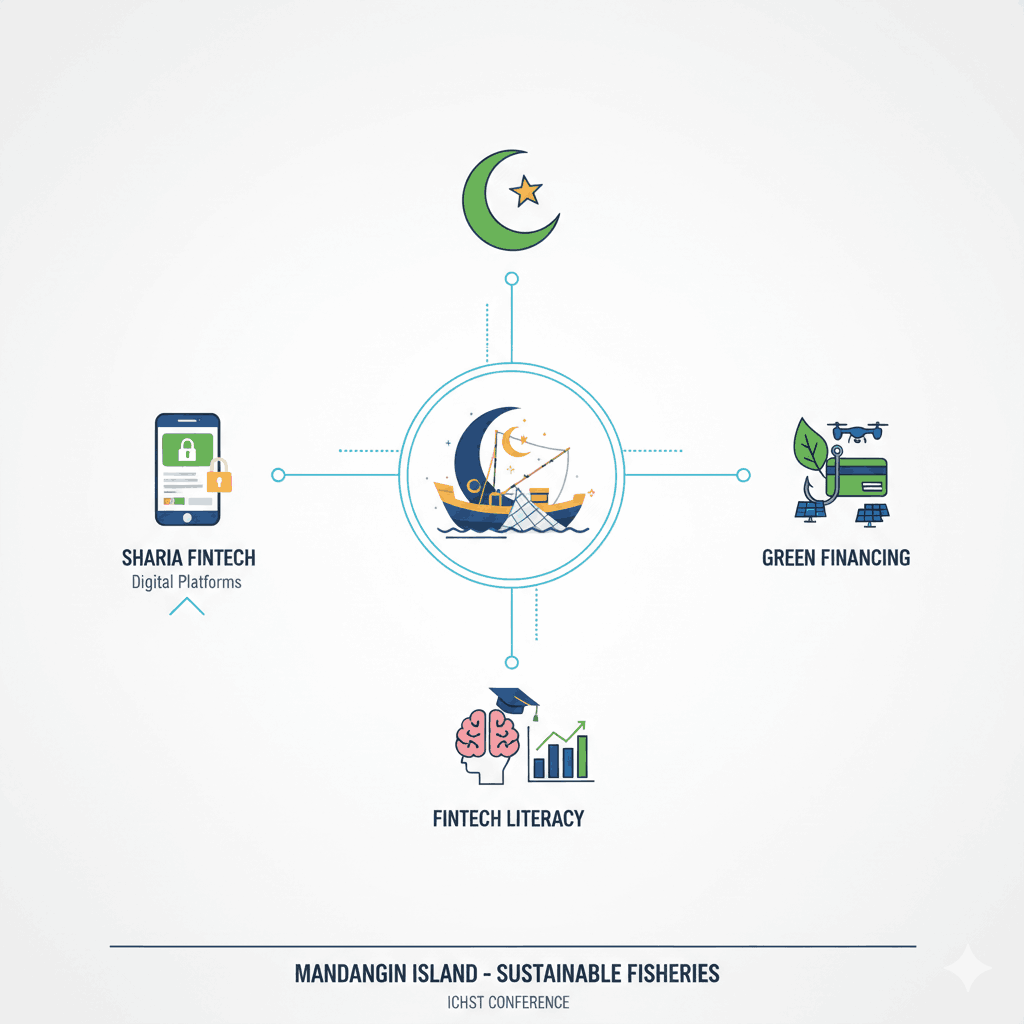
Fishermen communities on Mandangin Island, Sampang, primarily operate within a traditional economic model where livelihoods are limited to intermediate transactions with suppliers, resulting in long-term economic vulnerability and hindering the realization of sustainable welfare. This study aims to optimize the strategic role of Sharia banks in enhancing the economic management and financial inclusion of fishermen by explicitly addressing current challenges through the lens of Sustainability and Technology, aligning with the critical themes of the ICHST conference. Employing a qualitative descriptive approach, the research utilized in-depth fieldwork to assess the fishermen's existing financial practices and barriers to adopting modern financial instruments. The findings demonstrate that optimization efforts must move beyond conventional banking outreach and pivot towards a digital-centric model across three strategic areas: first, transitioning Sharia banks' presence from physical location-based access to robust digital platforms; second, elevating fishermen's knowledge from basic product understanding to comprehensive Sharia FinTech literacy; and third, redesigning bank contributions to focus on sustainable financing (Green Financing) for eco-friendly fishing tools and digitally-enabled micro-businesses. Ultimately, the effective integration of Sharia principles with proactive digital outreach can transform the local fishing economy into a sustainable, modern, and resilient system, providing a replicable model for other communities within participating countries.
Downloads
References
Abba, A. (2025). Sustainable management of water hyacinth (Eichhornia crassipes): Community-led strategies for livelihood enhancement in rural India. Results in Engineering. https://doi.org/10.1016/j.rineng.2024.105004
Anhar, J., Darmayanti, R., & dkk. (2023). Pengaruh kompetensi guru agama Islam terhadap implementasi manajemen sumber daya manusia di Madrasah Tsanawiyah. Assyfa Journal of Islamic Studies, 1(1), 86-95.
Ardiansah, I. (2021). The coral reef health at surrounding blue swimming crab fishery sites in Mandangin Island, East Java, Indonesia. IOP Conference Series: Earth and Environmental Science, 944(1). https://doi.org/10.1088/1755-1315/944/1/012021
Ayisi, C. L. (2023). Examining the socio-economic characteristics, fishing patterns, and challenges of fishermen at James Town in Ghana. Social Sciences and Humanities Open, 8(1). https://doi.org/10.1016/j.ssaho.2023.100591
Azhari, C. A., Cahyani, A., Wibowo, W., Santoso, T. N., & dkk. (2024). Kajian strategik manajemen pendidikan tinggi dalam perspektif filsafat ilmu. Google Books.
Bakhri, S. (2023). The strategic role of m-banking service quality in driving customer satisfaction for financial inclusion. Jurnal Ekonomi Syariah.
Bennett, N. J. (2020). Social equity and marine protected areas: Perceptions of small-scale fishermen in the Mediterranean Sea. Biological Conservation, 244. https://doi.org/10.1016/j.biocon.2020.108531
Bustomi, A. A., Suadi, S., & Yusuf, Y. (2025). Can technology transform tradition? Examining the impact of game-based learning and AI in Islamic boarding schools and rural industries. International Conference on Games-Based Learning, 1(1).
Chiavazza, H. (2021). Fishermen of the desert: Occupation and subsistence on the west side of the Desaguadero river (west-central Argentina) between ca. 1200 and 400 0bp. Chungara, 53(2), 215-236. https://doi.org/10.4067/S0717-73562021005001102
Chowdhury, T. A. (2021). Applying and extending the sustainable livelihoods approach: Identifying the livelihood capitals and wellbeing achievements of indigenous people in Bangladesh. Journal of Social and Economic Development. https://doi.org/10.1007/s40847-021-00163-z
Dang, P., & Li, J. (2025). Exploring the influence mechanism of tourism-related livelihood strategies on sustainable livelihoods from a common prosperity perspective, China. Discover Sustainability. https://doi.org/10.1007/s43621-025-01996-y
Darmayanti, R. (2022). Digital comic learning media based on character values on students’ critical thinking in solving mathematical problems in terms of learning styles. SSRN.
Darmayanti, R. (2024). Educational transformation: Reviewing Sheikh Nawawi's educational philosophy. Assyfa Journal of Islamic Studies, 1(2).
De Jesús Balderas-Mancilla, U. (2023). Knowledge and perception of the neotropical otter (Lontra longicaudis annectens) among fishermen in the Champayán lagoon system, Altamira, Tamaulipas, Mexico. IUCN SSC Otter Specialist Group Bulletin, 40.
de la Puente, S., de la Lama, R. L., Llerena-Cayo, C., & dkk. (2022). Adoption of sustainable low-impact fishing practices is not enough to secure sustainable livelihoods and social wellbeing in small-scale fishing communities. Marine Policy. https://doi.org/10.1016/j.marpol.2022.105151
Farghali, M. (2023). Social, environmental, and economic consequences of integrating renewable energies in the electricity sector: A review. Environmental Chemistry Letters, 21(3), 1381–1418. https://doi.org/10.1007/s10311-023-01587-1
Febrian, S., Sumardin, T. G., Yahya, A. A., Sari, S. A. P., Haryvalen, A. F., & Nurhidayat, S. (2024). Maintaining cleanliness and encouraging the local economy (the role of the waste bank in Pohijo Village). Jurnal Inovasi Dan Pengembangan Hasil Pengabdian Masyarakat, 1.
Giannakis, E. (2020). Regional disparities in economic resilience in the European Union across the urban–rural divide. Regional Studies. https://doi.org/10.1080/00343404.2019.1698711
Giovani, N., Pratami, R. D., & Arifin, R. (2023). Efforts to regenerate local tourism: Using empty land as a fishing spot. Jurnal Inovasi Dan Pengembangan Hasil Pengabdian Masyarakat, 1, 13–17.
Holland, D. S. (2020). Fishing to live or living to fish: Job satisfaction and identity of west coast fishermen. Ambio, 49. https://doi.org/10.1007/s13280-019-01205-2
Hu, X. (2022). What matters for regional economic resilience amid COVID-19? Evidence from cities in Northeast China. Cities, 120. https://doi.org/10.1016/j.cities.2021.103440
Inganah, S., Darmayanti, R., & Rizqi, N. (2023). Problems, solutions, and expectations: 6C integration of 21st century education into learning mathematics. JEMS (Journal of Mathematics and Science Education), 11(1), 220-238.
Irbathy, S. A., Mukminin, M. A., Yuldashev, A. A., & Ramdhan, T. W. (2025). Developing a religion tolerance-based character education framework for elementary school students. Al-Adzka: Jurnal Ilmiah Pendidikan Guru Madrasah Ibtidaiyah.
Legatzke, H., Current, D., & LaPan, C. (2025). Applying the sustainable livelihoods framework to examine the efficacy of community-based tourism at equitably promoting local livelihood opportunities. Tourism Planning & Development. https://doi.org/10.1080/21568316.2024.2391509
Mayor, M. (2020). Regions and economic resilience: New perspectives. Sustainability Switzerland, 12(11). https://doi.org/10.3390/su12114693
Mukminin, M. A., & Rhamadan, W. (2024). Kontekstualisasi hadis tarbawi tentang pengetahuan dan akhlak dalam pendidikan islam modern. Gahwa, 2(2), 62-79.
Natarajan, N. (2022). A sustainable livelihoods framework for the 21st century. World Development, 155. https://doi.org/10.1016/j.worlddev.2022.105898
Nursaid, N., Haanurat, A. I., Bakhri, S., & Rahman, A. (2024). Exploring the Shari’ah economic learning model through virtual learning: Initiatives and challenges. Assyfa Journal of Islamic Studies, 2, 141–150.
Nyoto, N. (2023). Bakar Tongkang Festival in Bagansiapiapi, Indonesia – from Chinese Fisherman Ritual to Tourism and Economic Impact. Review of Applied Socio Economic Research, 26(2), 83–93. https://doi.org/10.54609/reaser.v26i2.402
Opiyo, S. B., Opinde, G., & Letema, S. (2024). A perspective of sustainable livelihood framework in analysis of sustainability of rural community livelihoods: evidence from Migori River watershed in Kenya. International Journal of River Basin Management. https://doi.org/10.1080/15715124.2023.2216019
Pasanchay, K. (2021). Community-based tourism homestays' capacity to advance the Sustainable Development Goals: A holistic sustainable livelihood perspective. Tourism Management Perspectives, 37. https://doi.org/10.1016/j.tmp.2020.100784
Prabowo, B. (2023). Irrelationship between live coral cover and reef fish: An interim study of marine habitat dynamic on Mandangin Islands. IOP Conference Series: Earth and Environmental Science. https://doi.org/10.1088/1755-1315/1244/1/012024
Rahmatunisa, A. (2025). The influence of socio-economic factors on the food consumption diversification of fisherman’s households in Bontang City East Kalimantan. IOP Conference Series: Earth and Environmental Science, 1497(1). https://doi.org/10.1088/1755-1315/1497/1/012032
Ridwan, N. K. (2008). NU dan Neoliberalisme; Tantangan dan Harapan Menyongsong Satu Abad. Google Books.
Rozi Nasrul, M. (2021). Live and dead coral cover mapping using PlanetScope image around Mandangin Island, Madura, Indonesia. Proceedings of SPIE the International Society for Optical Engineering, 12082. https://doi.org/10.1117/12.2619448
Saputri, F., Setyawidyastuti, M., Cahyani, A., Setiyawan, D., & Nurhidayat, S. (2024). Introducing and Development of Cassava Rengginang MSMEs “Bu Tarni” Pagerukir Village: NIB and Halal Certification. Jurnal Inovasi Dan Pengembangan Hasil Pengabdian Masyarakat, 1, 136–145.
Sebayang, N. S., & Baroud, N. (2024). Sustainable aquaculture: Increasing fish productivity with environmentally friendly techniques in Indonesia and Libya. Assyfa Journal of Farming and Agriculture, 2.
Shi, C., He, Y., & Li, H. (2023). How does ecological poverty alleviation contribute to improving residents’ sustainable livelihoods?—Evidence from Zhejiang Province, China. Sustainable Production and Consumption. https://doi.org/10.1016/j.spc.2023.09.002
Soltani, M. (2021). Environmental, economic, and social impacts of geothermal energy systems. Renewable and Sustainable Energy Reviews, 140. https://doi.org/10.1016/j.rser.2021.110750
Sunyigono, A. K. (2020). Analysis of personal entrepreneurship quality of the society in Mandangin Island. IOP Conference Series: Earth and Environmental Science. https://doi.org/10.1088/1755-1315/515/1/012034
Syafi'i, I., & Rosyidah, L. (2022). Model pengembangan kurikulum adaptif pada sekolah inklusif. Jurnal Penelitian Medan Agama.
Uekert, T. (2023). Technical, economic, and environmental comparison of closed-loop recycling technologies for common plastics. ACS Sustainable Chemistry and Engineering, 11(3), 965–978. https://doi.org/10.1021/acssuschemeng.2c05497
Ulfa, A. Y., Satnawati, S., Mutiah, H., Asra, A. A., & dkk. (2024). Mahasiswa Kampus Mengajar Angkatan 6 Berdampak. Jurnal PTI (Pendidikan).
Usman, M. (2024). Sustainable rural livelihoods in the face of climate-induced hazards in Pakistan: Nexus of coping mechanisms, determinants, and benefits. International Journal of Disaster Risk Reduction, 106. https://doi.org/10.1016/j.ijdrr.2024.104449
Ye, W., Wang, Y., Yang, X., & Wu, K. (2022). Understanding sustainable livelihoods with a framework linking livelihood vulnerability and resilience in the semiarid loess plateau of China. Land, 11(9). https://doi.org/10.3390/land11091500
Yusuf, Y. (2020). Determinan Nilai Perusahaan Berdasarkan Kepemilikan dan Aspek Makro Ekonomi. Keberlanjutan: Jurnal Manajemen Dan Jurnal Akuntansi, 5(1), 1–14.
Yusuf, Y. (2023). Faktor-faktor yang mempengaruhi keputusan investasi di pasar modal syariah. Jurnal Pasar Modal Dan Investasi Syariah, 6(3), 170–185.
Zada, M. (2022). Contribution of small-scale agroforestry to local economic development and livelihood resilience: Evidence from Khyber Pakhtunkhwa province (KPK), Pakistan. Land, 11(1). https://doi.org/10.3390/land11010071
Ženka, J. (2021). Industrial structure and economic resilience of non-metropolitan regions: An empirical base for the smart specialization policies. Land, 10. https://doi.org/10.3390/land10111246
Published
How to Cite
Conference Proceedings Volume
Section
License
Copyright (c) 2025 Proceeding of the Excellent Campus and Technology Conference

This work is licensed under a Creative Commons Attribution-ShareAlike 4.0 International License.





