
APOS Theory: Description of Mathematical Understanding Abilities in Two-Variable Linear Equations Systems in Terms of Auditory Learning Styles and Gender
Authors
-
 Wardha Rusti Nengtiyas
Universitas Nahdlatul Ulama Pasuruan, Indonesia
Wardha Rusti Nengtiyas
Universitas Nahdlatul Ulama Pasuruan, Indonesia
-
Cahya Mar’a Saliha Sumantri
Universitas Nahdlatul Ulama Pasuruan, Indonesia
Keywords:
APOS theory, Mathematical Understanding Abilities, Auditory Learning Syles, GenderAbstract
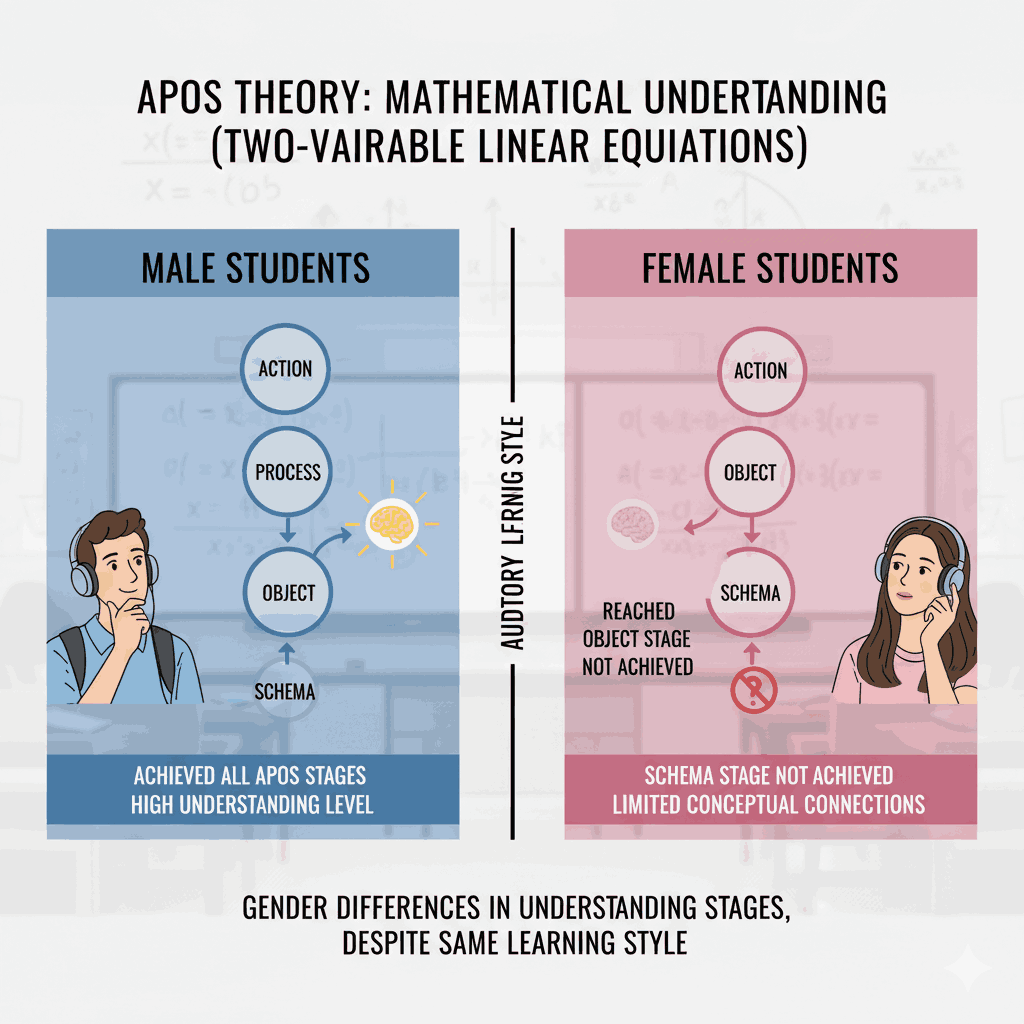
Mathematical understanding is an essential skill that every student must possess, as it helps them solve problems and apply learned concepts in daily life. According to APOS theory, mathematical understanding consists of four stages: action, process, object, and schema. Differences in individual achievement can be influenced by learning style and gender. This study aims to describe students’ mathematical understanding of the topic of Two-Variable Linear Equation Systems based on APOS theory, with a specific focus on the auditory learning style and gender. The research employed a descriptive qualitative approach. The subjects were Grade VIII-A students of MTs Miftahul Khoir, selected based on the results of a learning style questionnaire and gender data. The research instruments consisted of a mathematical understanding test and in-depth interviews to strengthen the data findings. The results showed differences in the level of understanding between male and female students with the same auditory learning style. Male students achieved all stages of APOS theory (action, process, object, and schema) and met all indicators of mathematical understanding, thus categorized as having a high level of understanding. In contrast, female students only reached the object stage and had not achieved the schema stage, indicating limitations in developing comprehensive conceptual connections. These findings affirm that gender differences can influence the achievement of mathematical understanding stages, even when the learning style is the same. The implications of this research can serve as input for teachers to design learning strategies that consider differences in learning styles and gender, so that all students can achieve optimal understanding
Downloads
References
A, H. A. (2018). Evaluasi Pembelajaran. Yogyakarta: Multi Pressindo.
Abubakar, M. (2021). Cognitive stages in learning linear equations. Journal of Mathematics Education, 14(2), 101-115.
Amelia, N. (2018). Pemahaman matematis berdasarkan teori APOS pada materi SPLDV. Jurnal Pendidikan Matematika, 56-99.
Arnon, I., Cottrill, J., Dubinsky, E., Oktaç, A., Fuentes, S. R., Trigueros, M., & Weller, K. (2023). APOS Theory: A Framework for Research and Curriculum Development in Mathematics Education. Springer Nature.
Arnawa, I. M., Yerizon, & Nita, S. (2021). Improvement of students' conceptual understanding of mathematics through the application of APOS theory-based instructional materials. Journal of Physics: Conference Series, 1788(1), 012054.
Baharuddin, M. (2020). Gender differences in solving mathematical word problems. Journal of Pedagogy, 5(1), 44-59.
Baye, M. G. (2021). Implementing GeoGebra integrated with multi-teaching approaches guided by the APOS theory to enhance students’ conceptual understanding of limit in Ethiopian Universities. Heliyon, 7(5), e07012.
Clements, D. H. (2023). Learning trajectories in early mathematics. Early Childhood Research Quarterly, 62, 1-12.
Dinullah, R. N. I. (2021). Analisis pemahaman konsep berdasarkan tahapan APOS peserta didik pada sistem persamaan linear dua variabel. Jurnal Pembelajaran Matematika Inovatif, 3(4), 282–295.
Donald, D. (2001). APOS: Teori Pembelajaran Konstruktivis dalam Penelitian Pendidikan Matematika Sarjana. Pengajaran dan Pembelajaran Matematika, 275-282.
Duit, R. (2022). Conceptual change in mathematics and science education. International Journal of Science Education, 44(8), 1234-1250.
Fahlevi, M. S., & Zanthy, L. S. (2021). Perbedaan gender siswa SMP kelas VIII. Jurnal Pembelajaran Matematika Inovatif, 4(3), 709–718.
Fauzi, A. (2021). Analysis of student's schema in solving SPLDV problems. Indonesian Journal of Mathematics Education, 4(2), 88-102.
Gresnigt, R. (2020). Integrated mathematics and science education. International Journal of STEM Education, 7, 1-15.
Hadi, S. (2022). Qualitative research methods in education. Journal of Educational Research, 15(3), 202-218.
Hanifah. (2016). Buku Model APOS Inovasi Pada Pembelajaran Matematika. Bengkulu: Unit Penerbitan FKIP Universitas Bengkulu.
Hernacki, B. D. (2010). Quantum Learning: Membiasakan Belajar Nyaman dan Menyenangkan. Bandung: Kaifa.
Herry Dwi Putra, H. S. (2018). Kemampuan Pemahaman Matematis. Kemampuan Pemahaman Matematis, 31-57.
Hidayat, N., Siskawati, F. S., & Irawati, T. N. (2023). Analisis kemampuan literasi matematika siswa dalam menyelesaikan soal aritmatika sosial ditinjau dari jenis kelamin. Jurnal Pendidikan, 12(2), 84–91.
Indonesia, D. P. (2003). UU No.20 Tahun 2003 tentang Sistem Pendidikan Nasional. Jakarta.
Ismail, S. (2023). The role of auditory learning in mathematical logic. Modern Education Review, 13(4), 312-325.
Jumarniati, J., Baharuddin, M. R., & Firman, S. (2021). Deskripsi kemampuan literasi matematis pada materi aritmatika sosial berdasarkan gender. EQUALS: Jurnal Ilmiah Pendidikan Matematika, 4(2), 123–132.
Karim, A. (2021). Purposive sampling techniques in qualitative studies. Methodological Reviews, 9(1), 45-56.
Khamidah, N. (2017). Indikator Pemahaman Konseptual dan Penggunaan Media Cerita Bergambar. Jakarta: Universitas Indonesia.
Kristina, K. (2019). Analisis Kemampuan Pemahaman Matematis Pada Materi Sistem Persamaan Linier Dua Variabel Berdasarkan Teori APOS Ditinjau Dari Gaya Belajar Peserta Didik. Skripsi.
Lestari, W. (2020). APOS analysis of geometry concepts. Mathematics Teaching and Learning, 2(1), 12-28.
Luritawaty, R. N. (2017). Perbandingan kemampuan pemahaman siswa yang menggunakan pembelajaran konvensional. Mosharafa: Jurnal Pendidikan Matematika, 19-25.
Maharaj, A. (2020). An APOS analysis of students’ understanding of the schema stage in advanced calculus. Mathematics Education Research Journal, 32, 1-22.
Masykur, M. (2023). Junior high school students' understanding of linear systems. Global Journal of Mathematics, 10(2), 77-89.
McDonald, E. D. (2020). APOS: A constructivist theory of learning in undergraduate mathematics education research. International Journal of Research in Undergraduate Mathematics Education, 1–22.
Moleong, J. L. (2017). Metodologi Penelitian Kualitatif. Bandung: Remaja Rosdakarya.
Morante Rodríguez, J. D. (2025). Comparing and contrasting APOS and Registers of Semiotic Representation theories: a possible integration. Educacion Matematica, 37(2), 226-245.
Mulyatna, S. (2016). Kemampuan pemahaman matematis siswa SMP. Jurnal Pendidikan Matematika, 23.
Mulyono. (2011). Teori APOS dan Implementasinya dalam Pembelajaran. Jakarta: I.
Mulyono, B., Sriwijaya, U., & Sriwijaya, U. (2018). Pemahaman konsep dalam pembelajaran matematika. Jurnal Elemen, 3(2), 103–122.
Murizal Angga, Y. Y. (2012). Pemahaman konsep matematis dan model pembelajaran. Jurnal Pendidikan Matematika, 19-23.
Ngandas, S. A., Ferdiani, R. D., & F., T. (2019). Analisis kemampuan pemahaman konsep matematika siswa SMP kelas VIII berdasarkan teori APOS. Jurnal Pendidikan Matematika, 2, 384–392.
Nuha, L. (2021). Analisis Pemahaman Konsep Matematis Menurut Teori APOS Ditinjau Dari Tipe Kepribadian. Thesis.
Nurajijah, M., Khaerunnisa, E., Anwar, C., & Fs, H. (2023). Kemampuan pemahaman konsep matematis siswa berdasarkan teori APOS pada materi program linear. Jurnal Educatio, 9(2), 785–797.
Oktaç, A. (2024). Mental constructions in the learning of mathematics: APOS theory. ZDM – Mathematics Education, 56(1), 1-15.
Patahuddin, S. M. (2022). Students' mental construction of variables: An APOS perspective. Journal of Mathematical Behavior, 65, 100922.
Rak, A. B. S. T. (2024). Analisis kemampuan koneksi matematis siswa SMP kelas VIII pada materi sistem persamaan linear dua variabel ditinjau dari gaya belajar. Jurnal Edukasi, 48–64.
Sugiyono. (2012). Metode Penelitian Pendidikan: Kuantitatif, Kualitatif, dan R&D. Bandung: Alfabeta.
Sugiyono. (2015). Metode Penelitian Pendidikan: Pendekatan Kuantitatif, Kualitatif, dan R&D. Bandung: Alfabeta.
Sugiyono. (2017). Metode Penelitian Pendidikan: Kuantitatif, Kualitatif, dan R&D. Bandung: Alfabeta.
Sugiyono. (2019). Metode Penelitian Kuantitatif, Kualitatif, dan R&D. Bandung: Alfabeta.
Sumaji. (2020). Mathematical communication process of junior high school students in solving problems based on APOS theory. Journal for the Education of Gifted Young Scientists, 8(1), 55-70.
Sutami, L. N. (2015). Analisis pemahaman konsep pada materi barisan dan deret berdasarkan teori APOS. Jurnal Pendidikan Matematika, 34-46.
Syafrilia. (2013). Analisis kegiatan berfikir siswa dalam matematika. Jurnal Riset Pendidikan Matematika, 23-33.
Syarifah, L. L. (2017). Analisis kemampuan pemahaman matematis pada mata kuliah pembelajaran matematika. Jurnal Gantang, 27-37.
Tall, D. (2020). Cognitive development of mathematical concepts. Educational Studies in Mathematics, 105, 1-18.
Trigueros, M., & Oktaç, A. (2021). APOS theory: A framework for research and curriculum development. Research in Undergraduate Mathematics Education, 215-230.
Wawan, A. T. (2018). Analisis pemahaman konseptual dan prosedural dalam menyelesaikan soal matematika. Jurnal Edukasi, 12-15.
Widada, W., & Jatmiko. (2020). The analysis of students' mathematical understanding based on APOS theory. Journal of Physics: Conference Series, 1460, 012015.
Zainuri, S. (2017). Analisis kemampuan pemahaman matematis. Jurnal Pendidikan Matematika, 33-45.
Zhang, J. (2026). A study on teaching derivatives based on APOS theory and multiple representation theory: A random forest approach. Proceedings of 2025 2nd International Conference on Artificial Intelligence and Future Education, 10.24844/EM3702.08.
Zormpala, K., & Barkatsas, T. (2024). Gender, motivation, and mathematical achievement: A contemporary perspective. International Journal of STEM Education, 11(1), 45-62.
Published
How to Cite
Conference Proceedings Volume
Section
License
Copyright (c) 2025 Proceeding of the Excellent Campus and Technology Conference

This work is licensed under a Creative Commons Attribution-ShareAlike 4.0 International License.





