
Digital Literacy as a Pillar of Sustainability in Islamic Boarding Schools: Strategies to Counter Hoaxes in the Technological Era
Authors
-
 Iis Riyana
Universitas Nahdlatul Ulama Pasuruan, Indonesia
-
Nur Hamida
-
Enik Sulistyowati
-
Rudi Kurniawan
Keywords:
Digital Literacy, Hoaxes, Islamic Boarding Schools, Sustainability, TechnologyAbstract
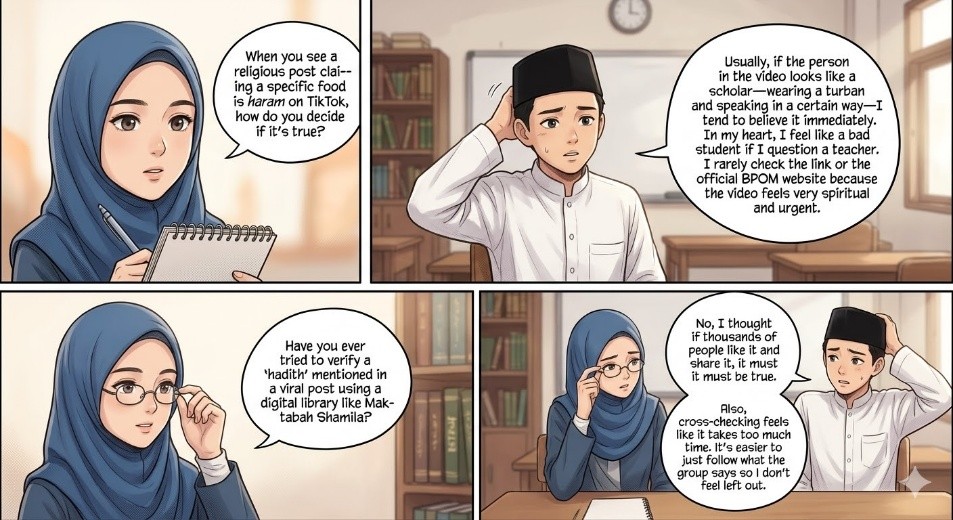
The phenomenon of digital disruption and the widespread spread of hoaxes poses a crucial challenge that threatens social cohesion (Humanity) in educational settings, especially for students at universities, which are at the crossroads of tradition and modernity. This study aims to formulate a sustainable digital literacy strategy model at Nahdlatul Ulama University, Pasuruan, to build intellectual resilience against disinformation. The approach used is a descriptive qualitative method through case studies involving students and teachers as key participants. Data were collected through in-depth interviews, participant observation, and document analysis, then analyzed using thematic coding to identify patterns of hoax exposure and information verification strategies. The results indicate that exposure to hoaxes remains high, especially those related to socio-religious issues. However, students have great potential for critical thinking (6C) if supported by a values-based curriculum. The best strategy was found to be integrating digital literacy into religious courses by utilizing ethical learning media technology, which resulted in increased awareness and the ability to verify information. This study concluded that strengthening digital literacy is not only a response to technological challenges, but also a key pillar in ensuring educational sustainability and maintaining the humanity of Islamic boarding school communities.
Downloads
References
Abidin, M. Z., Mispani, M., Yusuf, M., Setiawan, A., Wati, R. I., & Darmayanti, R. (2023). Implementasi Amaliyah Ahlussunnah Wal Jama’ah Dalam Mengatasi Perilaku Amoral Sebagai Upaya Pembentukan Akhlak Remaja. Assyfa Journal of Islamic Studies, 1(1), 51–62.
Adibus, A. (2023). Dynamics of Islamic Education in the Digital Era. Assyfa Journal of Islamic Studies, 1(2), 143–154.
Adomako, S., & Tran, M. D. (2024). Exploring the effect of R&D support, green technology transfer, sustainable innovation. Sustainable Development, 32(5), 4758–4769.
Affandi, G. N., Berlianti, P. C. G., Ramadhania, N. R., Abi Shawaaba, R. S., & Radianto, D. O. (2024). Efektivitas Pengolahan Limbah Fisik (Padat Dan Cair) Dengan Menggunakan Teknologi Inovatif. Jurnal Wilayah, Kota Dan Lingkungan Berkelanjutan, 3(1), 84–98.
Aisbett, E., Raynal, W., Steinhauser, R., & Jones, B. (2023). International green economy collaborations: Chasing mutual gains in the energy transition. Energy Research & Social Science, 104, 103249.
Aji, F. B., Nurmalitasari, D., Lestari, A. S. B., & Muhammad, I. (2023). Comedian Mathematical Thinking: An Islamic Examination of Inductive, Deductive, and Analogy Approaches in the Creation of Stand-Up Comedy Material. Assyfa Journal of Islamic Studies, 1(1), 24–30.
Al-Abbadi, L. H., Alshawabkeh, R., Alkhazali, Z., Al-Aqrabawi, R., & Rumman, A. A. (2025). Business intelligence and strategic entrepreneurship for sustainable development goals (SDGs) through: (green technology innovation and green knowledge management). Economics-Innovative and Economics Research Journal, 13(1), 45–68.
Al‐Raeei, M. (2025). The smart future for sustainable development: Artificial intelligence solutions for sustainable urbanization. Sustainable Development, 33(1), 508–517.
Anhar, J., Darmayanti, R., & dkk. (2023). Pengaruh kompetensi guru agama Islam terhadap implementasi manajemen sumber daya manusia di Madrasah Tsanawiyah. Assyfa Journal of Islamic Studies, 1(1), 86–98.
Anisah, A. (2023). Implementation strengthening education character through Islamic boarding schools. Assyfa Journal of Islamic Studies, 1(1), 72–85.
Azhari, C. A., Cahyani, A., Wibowo, W., & Santoso, T. N. (2024). Kajian strategik manajemen pendidikan tinggi dalam perspektif filsafat ilmu. Jakarta: Books Google.
Barbier, E. B. (2016). Building the green economy. Canadian Public Policy, 42(s1), S1–S9.
Bian, J., & Guo, X. (2022). Policy analysis for emission-reduction with green technology investment in manufacturing. Annals of Operations Research, 316(1), 5–32.
Billatos, S. (1997). Green technology and design for the environment. CRC Press.
Blau, I. (2020). How does the pedagogical design of a technology-enhanced collaborative academic course promote digital literacies, self-regulation, and perceived learning of students? Internet and Higher Education, 45, 100722.
Booth, A., Martyn-St James, M., Clowes, M., & Sutton, A. (2021). Systematic approaches to a successful literature review. Sage Publications.
Brocke, J. vom, Simons, A., Niehaves, B., Riemer, K., Plattfaut, R., & Cleven, A. (2009). Reconstructing the giant: On the importance of rigour in documenting the literature search process. ECIS Proceedings.
Cheng, P., Wang, X., Choi, B., & Huan, X. (2023). Green finance, international technology spillover and green technology innovation: A new perspective of regional innovation capability. Sustainability, 15(2), 1112.
Comin, L. C., Aguiar, C. C., Sehnem, S., Yusliza, M.-Y., Cazella, C. F., & Julkovski, D. J. (2020). Sustainable business models: A literature review. Benchmarking: An International Journal, 27(7), 2028–2047.
Cooper, H. M. (1988). Organizing knowledge syntheses: A taxonomy of literature reviews. Knowledge in Society, 1(1), 104.
Dabbous, A., & Barakat, K. A. (2023). The road towards environmental sustainability: Investigating the role of information and communication technologies and green technology innovations. Journal of Cleaner Production, 432, 139826.
Darmayanti, R., Fikri, M., & Rahman, M. A. (2023). Student learning outcomes will improve when using counting box media. How significant is the impact of this media? Assyfa Journal of Islamic Studies, 1(2), 143–154.
Darmayanti, R., & Fikri, M. (2023). Religious Digital Resilience: Bridging Pesantren Tradition and Modern OSINT Tools. Journal of Islamic Education and Technology, 4(1), 12-28.
Darmayanti, R. (2022). Digital comic learning media based on character values on students’ critical thinking in solving mathematical problems in terms of learning styles. Available at SSRN.
Dzwigol, H., Kwilinski, A., Lyulyov, O., & Pimonenko, T. (2023). The role of environmental regulations, renewable energy, and energy efficiency in finding the path to green economic growth. Energies, 16(7), 3090.
Engeness, I. (2021). Developing teachers’ digital identity: towards the pedagogic design principles of digital environments to enhance students’ learning in the 21st century. European Journal of Teacher Education.
Eshbayev, O., Xursandov, K., Pulatovna, K. U., Sitora, A., & Jamalova, G. (2024). Advancing green technology systems through digital economy innovations: A study on sustainable development. E3S Web of Conferences, 576, 02009.
Feng, S., Zhang, R., & Li, G. (2022). Environmental decentralization, digital finance and green technology innovation. Structural Change and Economic Dynamics, 61, 70–83.
Gibbs, D., & O’Neill, K. (2015). Building a green economy? Sustainability transitions in the UK building sector. Geoforum, 59, 133–141.
Guo, M., Nowakowska-Grunt, J., Gorbanyov, V., & Egorova, M. (2020). Green technology and sustainable development: Assessment and green growth frameworks. Sustainability, 12(16), 6571.
Hadi, L., Kuswanto, W., Tarmudi, I., & Mukhlisin, M. (2024). Keanekaragaman hayati: Merawat alam, menjaga keseimbangan. Indigo Media.
Hanna, E., & Comín, F. A. (2021). Urban green infrastructure and sustainable development: A review. Sustainability, 13(20), 11498.
Houssam, N., Ibrahiem, D. M., Sucharita, S., El-Aasar, K. M., Esily, R. R., & Sethi, N. (2023). Assessing the role of green economy on sustainable development in developing countries. Heliyon, 9(6).
Humaidi, M. N., Triansyah, F. A., Sugianto, R., & Laila, A. R. N. (2023). Development of a HOTS-Leveled two-tier multiple choice (ttmc) test to measure student misconceptions in islamic studies. Assyfa Journal of Islamic Studies, 1(1), 31–40.
Huzaini, H. (2023). Dynamics of Islamic Family Law: Husband Accuses Wife of Adultery Without Evidence and Witnesses (Sumpah Lian) Imam Abu Hanifah's Perspective. Assyfa Journal of Islamic Studies, 1(2), 162–170.
Immadisetty, A. (2024). Sustainable innovation in digital technologies: A systematic review of energy-efficient computing and circular design practices. International Journal of Computer Engineering And Technology, 15(06), 1056–1066.
Inganah, S., Darmayanti, R., & Rizqi, N. (2023). Problems, solutions, and expectations: 6C integration of 21st century education into learning mathematics. JEMS (Journal of Mathematics and Science Education), 11(1), 220–238.
Irbathy, S. A., Mukminin, M. A., Yuldashev, A. A., & Ramdhan, T. W. (2025). Developing a religion tolerance-based character education framework for elementary school students. Al-Adzka: Jurnal Ilmiah Pendidikan Guru Madrasah Ibtidaiyah.
Irsa, M. J. (2025). Analysis of Telkom Five Bold Moves and Telkom Go Zero% Strategy on Business Sustainability of PT Telkom Indonesia (Tbk) in the Digital Business Era. Formosa Journal of Applied Sciences, 4(5), 1459–1466.
Khalid, S., Stecenko, I., Kadirova, Z., Nurieva, A., & Gazieva, S. (2023). Sustainable development goals through the triad of green economy, growth, and deal. Journal of Environmental Management and Tourism, 21, 1376–1385.
Khan, N., Ray, R. L., Sargani, G. R., Ihtisham, M., Khayyam, M., & Ismail, S. (2021). Current progress and future prospects of agriculture technology: Gateway to sustainable agriculture. Sustainability, 13(9), 4883.
Krajnc, D., Kovačič, D., Žunec, E., Brglez, K., & Kovačič Lukman, R. (2022). Youth awareness and attitudes towards a circular economy to achieve the green deal goals. Sustainability, 14(19), 12050.
Kwilinski, A., Lyulyov, O., & Pimonenko, T. (2023). Environmental sustainability within attaining sustainable development goals: The role of digitalization and the transport sector. Sustainability, 15(14), 11282.
Laila, A. R. N., Cholily, Y. M., Syaifuddin, M., Darmayanti, R., Sugianto, R., & Muhammad, I. (2024). Desain Modul Matematika Bilingual: Urgensi Pengembangan Media Matematika Bilingual dengan konten Islami. Assyfa Journal of Islamic Studies, 2(1), 87–96.
Lasut, E. B. (2024). Analisis Kebijakan Indonesia Terkait Emisi Karbon Melalui Carbon Offsetting and Reduction Scheme for International Aviation (CORSIA). Jurnal Hukum Lingkungan.
Lee, C.-C., Wang, C., He, Z., Xing, W., & Wang, K. (2023). How does green finance affect energy efficiency? The role of green technology innovation and energy structure. Renewable Energy, 219, 119417.
Lei, L., & Lazareva, E. I. (2024). Financial incentive instruments of regional economy’s «green» transformation. State and Municipal Management Scholar Notes, 3, 78–85.
Liu, Y., Yang, Y., Zhang, X., & Yang, Y. (2024). The impact of technological innovation on the green digital economy and development strategies. Plos One, 19(4), e0301051.
Lu, M., Daixu, L., Peng, W., & Ruiqi, M. (2023). Heterogeneous environmental regulation tools and green economy development: Evidence from China. Environmental Research Communications, 5(1), 015007.
Luo, Y. (2020). Research on the development of economic transformation green agriculture based on sustainable environment green technology. International Journal of Environmental Technology and Management, 23(2–4), 91–100.
Mof, Y., Ramadan, W., & Mizani, H. (2026). Evaluating the Effectiveness of the Santripreneur Program in Islamic Boarding School: A CIPP-Based Qualitative Assessment of Screenprinting Training. Munaddhomah, 7(1), 141–156.
Muarif, I. (2025). Implementasi kebijakan ekonomi hijau pada pertumbuhan ekonomi dan kesejahteraan masyarakat. Jurnal Akuntansi, Keuangan, Perpajakan Dan Tata Kelola Perusahaan, 2(3), 961–967.
Mubarok, M. Z., Mispani, M., & Darmayanti, R. (2024). Assyfa Journal of Islamic Studies. Academia.edu.
Mukminin, M. A., Siri, A., & Sakdi, S. (2025). Model Pembelajaran Bagi Anak Yang Berhadapan Dengan Hukum Di Rutan Kelas I Bandung, Kebon Waru. Maslahat: Jurnal Pengabdian Kepada Masyarakat, 6(1), 11–15.
Mukminin, M. A., & Rhamadan, W. (2024). Kontekstualisasi hadis tarbawi tentang pengetahuan dan akhlak dalam pendidikan islam modern. Gahwa, 2(2), 62–79.
Mukminin, M. A., Muzawwir, A., Sohib, M., Mukit, A., & Zahiroh, A. (2025). Revisiting the Legacy of Hafshah bint Umar ibn al-Khattab: Towards a Model of Contemporary Muslimah Education. Syaikhuna: Jurnal Pendidikan dan Pranata Islam.
Pan, S.-Y., Gao, M., Kim, H., Shah, K. J., Pei, S.-L., & Chiang, P.-C. (2018). Advances and challenges in sustainable tourism toward a green economy. Science of the Total Environment, 635, 452–469.
Pandia, W. S. S., & Drew, A. (2023). Identifying and solving Islamic religious education challenges for special needs children. Assyfa Journal of Islamic Studies, 1(2), 178–190.
Phan, T. C. (2024). Impact of green investments, green economic growth and renewable energy consumption on environmental, social, and governance practices to achieve the sustainable development goals: A sectoral analysis in the ASEAN economies. International Journal of Engineering Business Management, 16, 18479790241231725.
Prahara, R. S., Burhan, M. U., Manzilati, A., & Ekawaty, M. (2026). Islamic Educational Leadership and Women’s Entrepreneurial Empowerment: A Pathway to Alleviating Extreme Poverty in Mojokerto, Indonesia. Munaddhomah, 7(1), 60–76.
Putri, A., & Sari, N. (2024). Pembangunan Ekonomi Syariah: Peran Pembangunan Berkelanjutan Berbasis Ekonomi Hijau. Religion: Jurnal Agama, Sosial, Dan Budaya, 3(2), 401–408.
Rhodes, E. A. (2011). Literature reviews. The Volta Review, 111(1), 67–71.
Ritterbusch, G. D., & Teichmann, M. R. (2023). Defining the metaverse: A systematic literature review. IEEE Access, 11, 12368–12377.
Rizqi, N., & Darmayanti, R. (2022). Mapping the Digital Divide: A Study of Media Literacy in Islamic Higher Education. Journal of Educational Research, 5(2), 45-59.
Rydzewski, P. (2025). Digital inequality and sustainable development. Problemy Ekorozwoju, 20(1), 96–108.
Saifullah, S., & Shumaila, S. (2023). Islam and International Standards of Human Rights: An Analysis of Domestic Implementation of International Human Rights in Islamic Culture. Assyfa Journal of Islamic Studies, 1(1), 01–12.
Sethi, L., Behera, B., & Sethi, N. (2024). Do green finance, green technology innovation, and institutional quality help achieve environmental sustainability? Evidence from the developing economies. Sustainable Development, 32(3), 2709–2723.
Söderholm, P. (2020). The green economy transition: The challenges of technological change for sustainability. Sustainable Earth, 3(1), 6.
Song, A., Rasool, Z., Nazar, R., & Anser, M. K. (2024). Towards a greener future: How green technology innovation and energy efficiency are transforming sustainability. Energy, 290, 129891.
Subrahmanyam, S. (2025). Developing Green Skills for Sustainable Careers. In Integrating AI and Sustainability in Technical and Vocational Education and Training (TVET) (pp. 101–126). IGI Global Scientific Publishing.
Suharsiwi, S., Lestari, J. T., & Karim, S. (2024). Islamic content-based learning: Kindergarten illustrated narrative song "Lulu and Tom". Assyfa Journal of Islamic Studies, 2(1), 36–46.
Sungkawati, E. (2024). Opportunities and challenges: Adopting “blue-green economy” terms to achieve SDGs. Revenue Journal: Management and Entrepreneurship, 2(1), 01–13.
Susanto, S., Rahmawaty, F., & Siswanto, E. (2025). Penerapan teknologi green water IPAL dalam peningkatan kualitas sanitasi dan kesehatan lingkungan untuk pemberdayaan komunitas perkotaan. Jurnal Pembelajaran Pemberdayaan Masyarakat (JP2M), 6(3), 772–785.
Syafi'i, I., & Rosyidah, L. (2022). Model pengembangan kurikulum adaptif pada sekolah inklusif. Jurnal Penelitian Medan Agama, 13(1), 35-48.
Tahir, U., & Babar, H. (2024). The Role of Policy in Developing a Skilled Workforce for a Green Economy. Green Environmental Technology, 1(2), 78–87.
Tanveer, M., Khan, S. A. R., Umar, M., Yu, Z., Sajid, M. J., & Haq, I. U. (2022). Waste management and green technology: Future trends in circular economy leading towards environmental sustainability. Environmental Science and Pollution Research, 29(53), 80161–80178.
Usmani, M. S., Wang, J., Ahmad, N., Iqbal, M., & Ahmed, R. I. (2021). Mapping green technologies literature published between 1995 and 2019: A scientometric review from the perspective of the manufacturing industry. Environmental Science and Pollution Research, 28(23), 28848–28864.
Wahyudi, S. M. (2021). Manajemen Kurikulum Adaptif Dalam Meningkatkan Efektifitas Pembelajaran di Sekolah Dasar. Jurnal Pendidikan Dasar, 3(1), 107–118.
Wang, M., Zhu, C., Wang, X., Ntim, V. S., & Liu, X. (2023). Effect of information and communication technology and electricity consumption on green total factor productivity. Applied Energy, 347, 121366.
Wang, Q., Qu, J., Wang, B., Wang, P., & Yang, T. (2019). Green technology innovation development in China in 1990–2015. Science of the Total Environment, 696, 134008.
Wani, M. J. G., Loganathan, N., & Esmail, H. A. H. (2024). Impact of green technology and energy on green economic growth: Role of FDI and globalization in G7 economies. Future Business Journal, 10(1), 43.
Wihlborg, E. (2023). Institutional Re-design for a Digital Era - Learning from Cases of Automation. Lecture Notes in Computer Science, 14153, 99-113.
Yikun, Z., Leong, L. W., Abu-Rumman, A., Shraah, A. A., & Hishan, S. S. (2023). Green growth, governance, and green technology innovation. How effective towards SDGs in G7 countries? Economic Research-Ekonomska Istraživanja, 36(2).
Yin, S., Zhang, N., & Li, B. (2020). Enhancing the competitiveness of multi-agent cooperation for green manufacturing in China: An empirical study of the measure of green technology innovation capabilities and their influencing factors. Sustainable Production and Consumption, 23, 63–76.
Ying, J., Zhang, X., Zhang, Y., & Bilan, S. (2022). Green infrastructure: Systematic literature review. Economic Research-Ekonomska Istraživanja, 35(1), 343–366.
Younas, S., Shoukat, S., Awan, A., & Arslan, S. M. (2023). Comparing effects of green innovation and renewable energy on green economy: The metrics of green economy as nucleus of SDGs. Pakistan Journal of Humanities and Social Sciences, 11(2), 1035–1051.
Zahroh, U., Rachmawati, N. I., Darmayanti, R., & Tantrianingrum, T. (2023). "Guidelines" for collaborative learning in 21st century education at Madrasah Tsanawiyah. Assyfa Journal of Islamic Studies, 1(2), 155–161.
Zakari, A., Khan, I., Tan, D., Alvarado, R., & Dagar, V. (2022). Energy efficiency and sustainable development goals (SDGs). Energy, 239, 122365.
Zhang, L., Saydaliev, H. B., & Ma, X. (2022). Does green finance investment and technological innovation improve renewable energy efficiency and sustainable development goals. Renewable Energy, 193, 991–1000.
Zhironkin, S., & Cehlár, M. (2022). Green economy and sustainable development: The outlook. Energies, 15(3), 1167.
Zioło, M., Bąk, I., Cheba, K., & Spoz, A. (2020). Sustainable business models of enterprises-actual and declared activities for ensuring corporate sustainability. Procedia Computer Science, 176, 1497–1506.
Published
How to Cite
Conference Proceedings Volume
Section
License
Copyright (c) 2025 Proceeding of the Excellent Campus and Technology Conference

This work is licensed under a Creative Commons Attribution-ShareAlike 4.0 International License.





