
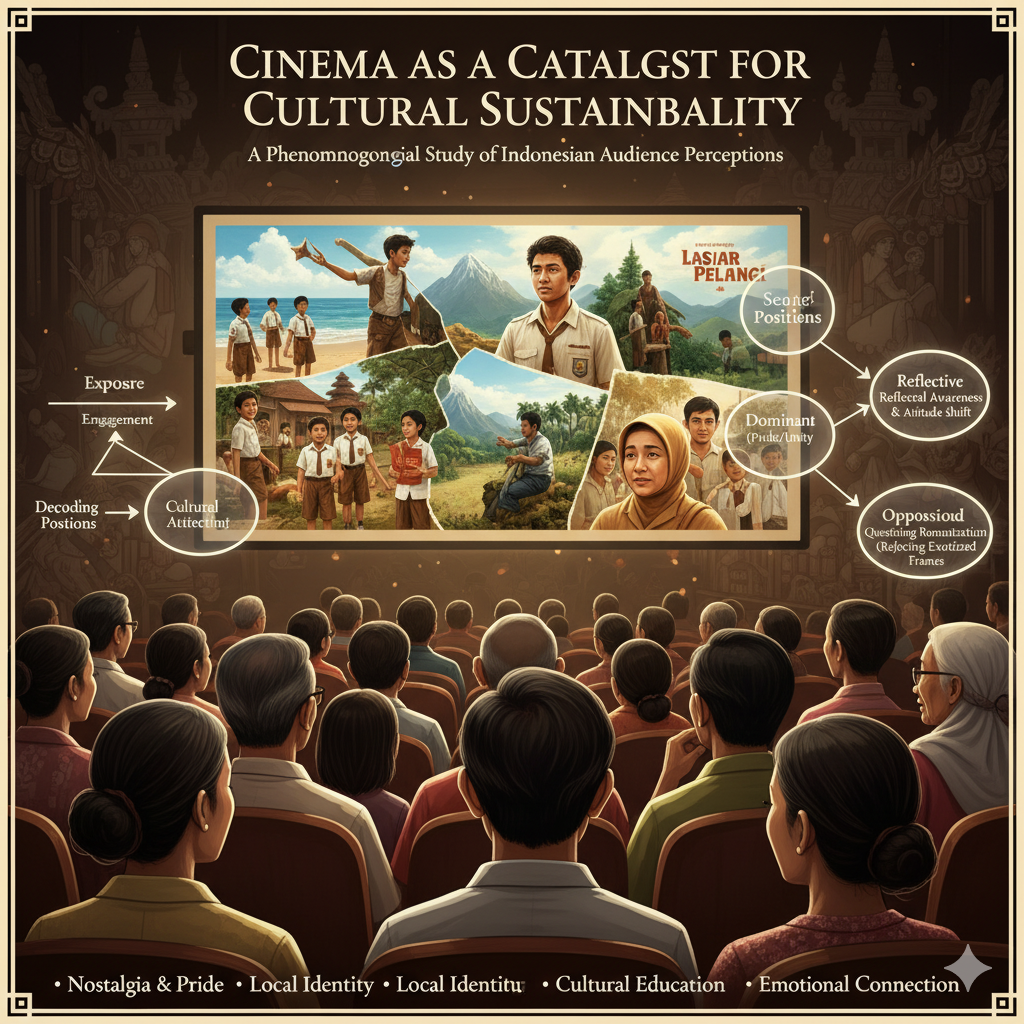
Cinema as a Catalyst for Cultural Sustainability: A Phenomenological Study of Indonesian Audience Perceptions
Authors
-
 Dwi Prasetyo
Universitas Negeri Surabaya
-
Tia Saraswati
-
Teguh Dwi Putranto
Keywords:
cultural shock, hoax prevention, pesantrenAbstract
This study explores how Indonesian audiences perceive and interpret the representation of local culture in culturally themed films, and how these experiences contribute to cultural sustainability. Using an Interpretative Phenomenological Analysis (IPA) approach, we conducted in-depth, semi-structured interviews with 12 participants aged 18–45 who had viewed films such as Laskar Pelangi, Denias, and Sang Pemimpi. Data were analyzed via a six-stage IPA workflow. The analysis revealed four major phenomenological themes: (1) nostalgia and cultural pride, (2) reflection on local identity, (3) film as a cultural education medium, and (4) emotional connection to cultural narratives. These findings show that culturally themed films serve not only as entertainment but as catalysts for identity reinforcement, intergenerational knowledge transfer, and empathy-driven cultural awareness. The study situates these results within Cultural Sustainability Theory and Media Representation Theory, demonstrating the potential of cinema to act as a bridge between diverse cultural communities in Indonesia. The research offers theoretical and practical insights for filmmakers, cultural policymakers, and educators, indicating that intentional cultural representation can strengthen national identity and motivate preservation efforts; it also informs curricular design and community-based screening initiatives. While limited in scope, this study underscores the transformative role of cinema in sustaining intangible cultural heritage (ICH) and calls for broader, comparative research to better understand media’s role in cultural sustainability.
Downloads
References
Afifulloh, M. (2025). K-drama and Indonesian film hybridity in shaping youth identity: A postcolonial study. International Journal of Innovative Research and Scientific Studies, 8(1), 939–947. https://doi.org/10.53894/ijirss.v8i1.4470
Agarwal, N., Agarwal, E., & Hipona, J. B. (2024). Role of media and communication on sustainable entrepreneurship. In Sustainable Partnership and Investment Strategies for Startups and SMEs (pp. 178–191). IGI Global. https://doi.org/10.4018/979-8-3693-2197-3.ch010
Alevizou, P. J., Henninger, C. E., & Spinks, C. (2019). Communicating sustainability practices and values: A case study approach of a micro-organisation in the UK. International Journal of Business and Globalisation, 22(1), 37–52. https://doi.org/10.1504/IJBG.2019.097388
Alhazmi, A. A., & Kaufmann, A. (2022). Phenomenological Qualitative Methods Applied to the Analysis of Cross-Cultural Experience in Novel Educational Social Contexts. Frontiers in Psychology, 13. https://doi.org/10.3389/fpsyg.2022.785134
Arapoglou, E., Kalogeras, Y., & Nyman, J. (2016). Introduction. In Racial and Ethnic Identities in the Media (pp. 1–10). Palgrave Macmillan. https://doi.org/10.1057/978-1-137-56834-2_1
Aziz, N. A. A., Ariffin, N. F. M., Ismail, N. A., Ismail, S., Alias, A., & Utaberta, N. (2022). The Comparison of the Best Practices of the Community-Based Education for Living Heritage Site Conservation. In Y. L., N. U., A. O.G., & A. M. (Eds.), Lecture Notes in Civil Engineering (Vol. 161, pp. 1–8). Springer Science and Business Media Deutschland GmbH. https://doi.org/10.1007/978-981-16-2329-5_1
Banerjee, S. (2024). Film Festivals and Cultural Diplomacy: The Role of International Cinema in Global Relations. Shodh Sagar Journal of Language, Arts, Culture and Film, 1(1 SE-Original Research Articles), 36–41. https://doi.org/10.36676/jlacf.v1.i1.7
Bing, J.-B. (2015). The Indonesian cinema, distorting mirror of a changing society. Revue des Mondes Musulmans et de la Mediterranee, 137, 177–192. https://doi.org/10.4000/remmm.8527
Cerquetti, M., & Ferrara, C. (2018). Marketing research for cultural heritage conservation and sustainability: Lessons from the field. Sustainability (Switzerland), 10(3). https://doi.org/10.3390/su10030774
Chan, J. M., & Lee, F. L. F. (2017). Advancing comparative media and communication research. In Advancing Comparative Media and Communication Research. Taylor and Francis. https://doi.org/10.4324/9781315179285
Chang, C.-H., Tseng, H.-Y., & Chen, T.-S. (2024). Seeing Oneself in Others’ Stories: A Study on Audience Experience in Autobiographical Therapeutic Performance. Bulletin of Educational Psychology, 56(2), 429–452. https://doi.org/10.6251/BEP.202412_56(2).0009
Chang, J. (2024). The Construction of Cultural Identity in Multimodal Discourse Analysis under the Perspective of Media Convergence. Applied Mathematics and Nonlinear Sciences, 9(1). https://doi.org/10.2478/amns.2023.2.00478
Christensen, M., & Nilsson, A. E. (2018). Media, Communication, and the Environment in Precarious Times. Journal of Communication, 68(2), 267–277. https://doi.org/10.1093/joc/jqy004
Cubitt, S. (2014). Ecomedia futures. International Journal of Media and Cultural Politics, 10(2), 163–170. https://doi.org/10.1386/macp.10.2.163_1
Desilla, L. (2014). Reading between the lines, seeing beyond the images: An empirical study on the comprehension of implicit film dialogue meaning across cultures. Translator, 20(2), 194–214. https://doi.org/10.1080/13556509.2014.967476
Eatough, V., & Smith, J. A. (2006). I feel like a scrambled egg in my head: An idiographic case study of meaning making and anger using interpretative phenomenological analysis. Psychology and Psychotherapy: Theory, Research and Practice, 79(1), 115–135. https://doi.org/10.1348/147608305X41100
Gamage, A. (2025). A comparative analysis of qualitative and mixed methods research: Strengths, limitations, and practical applications. World Journal of Advanced Research and Reviews, 25, 2040–2046. https://doi.org/10.30574/wjarr.2025.25.3.0947
Gerbner, G. (1998). Cultivation Analysis: An Overview. Mass Communication and Society, 1(3–4), 175–194. https://doi.org/10.1080/15205436.1998.9677855
Grace, S. C. (2021). The intermingling of meanings in marketing: semiology and phenomenology in consumer culture theory. AMS Review, 11(1–2), 70–80. https://doi.org/10.1007/s13162-021-00192-1
Hall, S. (1997). Cultural Representations. A Cultural History of Hair in the Modern Age, 163–180. https://doi.org/10.5040/9798881817947.ch-8
Hanan, D. (2017). Cultural Specificity in Indonesian Film: Diversity in Unity. In Cultural Specificity in Indonesian Film: Diversity in Unity. Palgrave Macmillan. https://doi.org/10.1007/978-3-319-40874-3
Hefferon, K., & Gil-Rodriguez, E. (2011). Interpretative phenomenological analysis. In The Psychologist (Vol. 24, Issue 10, pp. 756–759). British Psychological Society.
Holohan, C. (2017). Introduction: Mapping the European cinematic. Studies in European Cinema, 14(1), 1–6. https://doi.org/10.1080/17411548.2017.1294838
Hunting, K. (2021). Critical content analysis: a methodological proposal for the incorporation of numerical data into critical/cultural media studies. Annals of the International Communication Association, 45(1), 39–58. https://doi.org/10.1080/23808985.2021.1910061
Izharuddin, A. (2017). Gender, Islam, and the Nation in New Order Islamic Films. In Gender, Sexualities and Culture in Asia (pp. 97–126). Springer Science and Business Media B.V. https://doi.org/10.1007/978-981-10-2173-2_4
Jiménez de Madariaga, C. (2021). Dry stone constructions – intangible cultural heritage and sustainable environment. Journal of Cultural Heritage Management and Sustainable Development, 11(4), 614–626. https://doi.org/10.1108/JCHMSD-12-2020-0180
Jin, D. Y., & Su, W. (2019). Asia-Pacific Film Co-productions: Theory, Industry and Aesthetics. In Asia-Pacific Film Co-productions: Theory, Industry and Aesthetics. Taylor and Francis. https://doi.org/10.4324/9781003011262
Kerrigan, S., & Batty, C. (2016). Re-conceptualising screenwriting for the academy: the social, cultural and creative practice of developing a screenplay. New Writing, 13(1), 130–144. https://doi.org/10.1080/14790726.2015.1134580
Kevseroğlu, Ö., Ayataç, H., & Baturayoğlu Yöney, N. (2021). Understanding intangible aspects of cultural landscape; living cultures of northeast kayseri valleys. Milli Folklor, 17(130), 185–203. https://www.scopus.com/inward/record.uri?eid=2-s2.0-85116109252&partnerID=40&md5=a24a3219565f6190f911522afb3dd7fd
Latif, R. A., & Hassan, B. R. A. (2020). Filmic education of borderland texts in Jogho and Bunohan. SEARCH Journal of Media and Communication Research, 12(1), 125–139. https://www.scopus.com/inward/record.uri?eid=2-s2.0-85089000356&partnerID=40&md5=0867cabe6e22793be2dec93c8b68acb2
Livingstone, S. (2015). Active Audiences? The Debate Progresses But Is Far From Resolved. Communication Theory, 25(4), 439–446. https://doi.org/10.1111/comt.12078
Michalik, Y. (2015). INDONESIAN WOMEN FILMMAKERS: Creating a new female identity? Indonesia and the Malay World, 43(127), 378–396. https://doi.org/10.1080/13639811.2015.1054139
Palinkas. (2015). Purposeful Sampling for Qualitative Data Collection and Analysis in Mixed Method Implementation Research. PG - 533-44 LID - 10.1007/s10488-013-0528-y [doi] (Issues 1573-3289 (Electronic)).
Petkanopoulou, Katerina, Wildschut, Tim, & Sedikides, Constantine. (2021). Nostalgia and Biculturalism: How Host-Culture Nostalgia Fosters Bicultural Identity Integration. Journal of Cross-Cultural Psychology, 52(2), 184–191. https://doi.org/10.1177/0022022120988345
Petrova, L. (2011). David Throsby: The economics of cultural policy. Journal of Cultural Economics, 35(3), 237–240. https://doi.org/10.1007/s10824-011-9138-2
Plantinga, C. R. (2009). Moving viewers : American film and the spectator’s experience. Berkeley : University of California Press. https://searchworks.stanford.edu/view/7904527
Potter, W. J. (2012). Media Effects. SAGE Publications, Inc. https://doi.org/10.4135/9781544308500
Purnama, A. (2023). Film style in Indonesian cinema, 1998-2018: Lighting, production design and camera movement. In Film Style in Indonesian Cinema, 1998-2018: Lighting, Production Design and Camera Movement. Edinburgh University Press. https://www.scopus.com/inward/record.uri?eid=2-s2.0-85212913587&partnerID=40&md5=62d1ddb536b02f11a21e8601ef131325
Rajala, A., Lindblom, D., & Stocchetti, M. (2020). The Political Economy of Local Cinema: A Critical Introduction. In The Political Economy of Local Cinema: A Critical Introduction. Peter Lang AG. https://doi.org/10.3726/b16846
Razali, M. F., Abu Hassan, B. R., & Latif, R. A. (2016). Disenfranchised arts and cultural heritage: What can film do? Jurnal Komunikasi: Malaysian Journal of Communication, 32(1), 651–668. https://www.scopus.com/inward/record.uri?eid=2-s2.0-84978745429&partnerID=40&md5=8a4add94abb362de92c62fa642019ea3
Schofield Clark, Lynn. (2008). Book Review: Roger Silverstone, Media and Morality: On the Rise of the Mediapolis. Cambridge: Polity Press, 2007. Vii + 215 pp. ISBN 0—7456—3504—0, $25.95 (pbk). New Media & Society, 10(3), 537–540. https://doi.org/10.1177/1461444808089419
Smith, H., Suldovsky, B., & Lindenfeld, L. (2016). Mass Communication Research in Sustainability Science: Moving Toward an Engaged Approach to Address Society’s Sustainability Dilemma. Mass Communication and Society, 19(5), 548–565. https://doi.org/10.1080/15205436.2016.1167916
Sola-Morales, S. (2016). Media and identification processes: A ritual and dramatic construction. Athenea Digital, 16(2), 247–269. https://doi.org/10.5565/rev/athenea.1448
Song, D. (2025). Hall’s encoding/decoding model revisited in the digital platform age: de/encoding, lincoding, affordecoding, and en/decoding. Information, Communication & Society, 1–19. https://doi.org/10.1080/1369118X.2025.2524571
Srdanović, P., Skala, T., & Maričević, M. (2025). InHeritage—A Gamified Mobile Application with AR and VR for Cultural Heritage Preservation in the Metaverse. Applied Sciences (Switzerland), 15(1). https://doi.org/10.3390/app15010257
Sugihartono, R. A., & Adi, S. P. (2024). Children’s Animation Films: The Cultural Advancement Perspective. Journal of Urban Culture Research, 29, 45–62. https://www.scopus.com/inward/record.uri?eid=2-s2.0-85216964727&partnerID=40&md5=8bcd62c5dbf86cb029183497918b7c55
Thies, S. (2020). Cinema. In The Routledge Handbook to the Culture and Media of the Americas (pp. 285–297). Taylor and Francis. https://doi.org/10.4324/9781351064705-25
Tindall, L. (2009). J.A. Smith, P. Flower and M. Larkin (2009), Interpretative Phenomenological Analysis: Theory, Method and Research. Qualitative Research in Psychology, 6(4), 346–347. https://doi.org/10.1080/14780880903340091
Tsatsou, P. (2016). Can media and communication researchers turn the present challenges of research impact and interdisciplinarity into future opportunities? International Communication Gazette, 78(7), 650–656. https://doi.org/10.1177/1748048516655718
Xue, K., Li, Y., & Meng, X. (2019). An evaluation model to assess the communication effects of intangible cultural heritage. Journal of Cultural Heritage, 40, 124–132. https://doi.org/10.1016/j.culher.2019.05.021
Yang, Yongzhong, Liu, Shuangji, & Song, Xiaoting. (2023). The Co-creation of Museum Experience Value From the Perspective of Visitor Motivation. SAGE Open, 13(4), 21582440231202120. https://doi.org/10.1177/21582440231202118
Zillmann, D. (2000). Mood Management in the Context of Selective Exposure Theory. Communication Yearbook, 23(1), 103–123. https://doi.org/10.1080/23808985.2000.11678971
Published
How to Cite
Conference Proceedings Volume
Section
License
Copyright (c) 2025 Proceeding of the Excellent Campus and Technology Conference

This work is licensed under a Creative Commons Attribution-ShareAlike 4.0 International License.





