
A Beyond Physicality: Systematic Review of Neuro-Linguistic Programming and Mental Imagery as Sustainable Pedagogical Tools in Physical Education and Sports
Authors
-
 Feri Weldani
Universitas PGRI Sumenep, Indonesia
Keywords:
Mental Imagery, Neuro-Linguistic Programming, Pedagogical Tools, Physical Education, Sustainable SportsAbstract
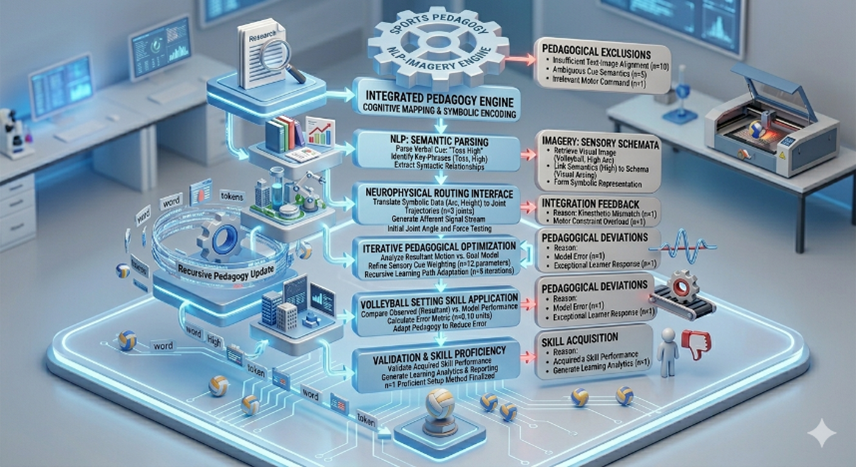
Beyond Physicality: Systematic Review of Neuro-Linguistic Programming and Mental Imagery as Sustainable Pedagogical Tools in Physical Education and SportsIn the current era of digital disruption and volatile educational landscapes, physical education students must possess high-level cognitive adaptability alongside physical prowess. Teaching strategies that integrate psychological technologies are now viewed as essential, creative, and effective frameworks to enhance these multifaceted skills. This systematic literature review is motivated by the historical over-reliance on physical-only drills, which often neglect the psychological barriers—such as anxiety and poor mental focus—that hinder motor skill acquisition in aquatic and field sports. While traditional research has focused on biomechanical evaluation, this study evaluates the integration of Neuro-Linguistic Programming (NLP) and Mental Imagery as interventions to improve cognitive-motor synergy and sustainable performance. The primary objective is to synthesize existing evidence on the efficacy of these "mental technologies" within sports pedagogy. Employing a PRISMA-guided systematic review methodology, this study analyzed peer-reviewed articles from 2015–2025 using cross-database synthesis. Findings indicate that NLP-based scaffolding and imagery significantly impact positive skill retention and psychological resilience, specifically in reducing "performance-anxiety" during complex motor tasks like swimming and gymnastics. However, findings also suggest that without consistent digital or instructor-led reinforcement, the effects on long-term physical conditioning may vary. In conclusion, integrating NLP and imagery provides a sustainable pedagogical shift from purely physical training to a holistic human-tech development model. This approach is vital for the future of physical education, ensuring students are mentally resilient and technically proficient.
Keywords: Mental Imagery, Neuro-Linguistic Programming, Pedagogical Tools, Physical Education, Sustainable Sports.
Downloads
References
Basri, M. H., Masodi, M., Prasetyo, D. A., & Weldani, F. (2025). Digital-Transformative Outbound Rekayasa Karakter Calon Guru PJOK Berbasis Experiential Learning (Edisi 1: Fondasi dan Dinamika Kelompok). In UNU PASURUAN PRESS (Vol. 1, p. 150). https://scholar.google.com/citations?view_op=view_citation&hl=en&user=Flo5L6EAAAAJ&pagesize=100&citation_for_view=Flo5L6EAAAAJ:5nxA0vEk-isC
Basri, M. H., Masodi, M., Weldani, F., & Prasetyo, D. A. (2025). FASILITASI OUTBOUND ADAPTIF &GAMIFIKASI: Panduan Ahli untuk Pengelolaan Dinamika Kelompok dan Peningkatan Karakter Calon Guru PJOK Abad 21. In UNU PASURUAN PRESS (Vol. 2, p. 150). https://scholar.google.com/citations?view_op=view_citation&hl=en&user=Flo5L6EAAAAJ&pagesize=100&citation_for_view=Flo5L6EAAAAJ:hqOjcs7Dif8C
Basri, M. H., Masodi, M., Weldani, F., & Prasetyo, D. A. (2026). Digital-Transformative Outbound Rekayasa Karakter Calon Guru PJOK Berbasis Experiential Learning (Edisi 2: Fondasi dan Dinamika Kelompok). In UNU PASURUAN PRESS (Vol. 2, p. 150). https://scholar.google.com/citations?view_op=view_citation&hl=en&user=Flo5L6EAAAAJ&pagesize=100&citation_for_view=Flo5L6EAAAAJ:0EnyYjriUFMC
Born, D.-P., Burkhardt, D., Buck, M., Schwab, L., & Romann, M. (2025). Key performance indicators and reference values for turn performance in elite youth, junior and adult swimmers. Sports Biomechanics, 24(7), 2085–2105. https://doi.org/10.1080/14763141.2024.2409657
Chacham-Guber, A., Sapir, Y., Goral, A., & Hutzler, Y. (2025). Assessing Aquatic Readiness as a Health-Enhancing Measure in Young Swimmers with Physical Disabilities: The Revised Aquatic Independence Measure (AIM-2). International Journal of Environmental Research and Public Health, 22(3). https://doi.org/10.3390/ijerph22030421
Day, D. (2010). London swimming professors: Victorian craftsmen and aquatic entrepreneurs. Sport in History, 30(1), 32–54. https://doi.org/10.1080/17460261003616690
de Jesus, E. E. D., Sperandio, J., Brasilino, F. F., & Morales, P. J. C. (2023). Anthropometry and aquatic skills of children who attend swimming. Sport TK, 12. https://doi.org/10.6018/sportk.568291
De Jesus, K., Figueiredo, P., Gonçalves, P., Fernandes, R. J., & Vilas-Boas, J. P. (2016). Neuromuscular activation in swimming and water polo. In Surface Electromyography: Fundamentals, Computational Techniques and Clinical Applications (pp. 1–34). Nova Science Publisher Inc. https://www.scopus.com/pages/publications/85043343912?origin=resultslist
Elorabi, K., Ishak, S., & Maher, M. (2024). Does the inflow of remittances diminish unemployment? The role of political stability in MENA countries. Journal of Economic Studies, 51(8), 1571–1585. https://doi.org/10.1108/JES-08-2023-0453
Erbaugh, S. J. (1986). Effects of aquatic training on swimming skill development of preschool children. Perceptual and Motor Skills, 62(2), 439–446. https://doi.org/10.2466/pms.1986.62.2.439
Esser-Noethlichs, M., & Hegland, L. (2026). PE teachers’ experiences with teaching outdoor swimming, self-rescue and lifesaving: A context for skill development or Bildung? European Physical Education Review, 32(2), 404–420. https://doi.org/10.1177/1356336X251358128
Isles, A. F., & Pearn, J. H. (2013). Swimming and survival: Two lessons from history. International Journal of Aquatic Research and Education, 7(2), 163–166. https://doi.org/10.25035/ijare.07.02.08
Kodssi, I. E., Sbai, H., & Mansour, N. A. (2026). PRISMA: Physically-Aware Reasoning and Intelligent Semantic Mining Architecture for IoT Process Discovery Using Deep Learning and Large Language Models. IEEE Access, 14, 32666–32689. https://doi.org/10.1109/ACCESS.2026.3664833
Masodi, M., Basri, M. H., Prasetyo, D. A., & Weldani, F. (2024). Manajemen Pendidikan Jasmani &E-Sport. In UNU PASURUAN PRESS (Vol. 2, p. 200). https://scholar.google.com/citations?view_op=view_citation&hl=en&user=9BgPsc8AAAAJ&pagesize=100&citation_for_view=9BgPsc8AAAAJ:HoB7MX3m0LUC
Naczk, A., Gajewska, E., & Naczk, M. (2021). Effectiveness of swimming program in adolescents with down syndrome. International Journal of Environmental Research and Public Health, 18(14). https://doi.org/10.3390/ijerph18147441
Nuraisyah, W., Rasyid, A., Weldani, F., Prasetyo, D. A., & Firdauz, N. W. R. (2023). Efektivitas Model Pembelajaran Langsung, Kooperatif Tipe TGT Dan Media Audio Visual Terhadap Hasil Keterampilan Tendangan Lurus Pada Mata Kuliah Pencak Silat. In PENJAGA: Pendidikan Jasmani Dan Olahraga (Vol. 3, Number 2, pp. 33–43). https://scholar.google.com/citations?view_op=view_citation&hl=en&user=Flo5L6EAAAAJ&pagesize=100&citation_for_view=Flo5L6EAAAAJ:u-x6o8ySG0sC
odi, M. M., Darmayanti, R., Basri, M. H., Prasetyo, D. A., Weldani, F., & ... (2025). Landscape Kompetensi Calon Guru Pjok Di STKIP PGRI Sumenep Melalui Pelaksanaan Kegiatan Outbound Di Bumi Perkemahan Bedengan Batu. Center of Education Journal (CEJou), 6(1), 9–20. https://scholar.google.com/citations?view_op=view_citation%5C&hl=en%5C&user=3YBrj-MAAAAJ%5C&cstart=100%5C&pagesize=100%5C&citation_for_view=3YBrj-MAAAAJ:1kzFgieWZDIC
Prasetyo, D. A., Basri, M. H., Mas’ odi, M. odi, & Weldani, F. (2025). Tren Global dan Prospek Game-Based Learning PJOK: Peningkatan Kompetensi Abad 21 Mendukung SDG 4, 3, dan 17 melalui Pendidikan Jasmani. Internasional Conference on Games Based Learning, 1(1), 14–25.
Prasetyo, D. A., Basri, M. H., odi, M. M., Weldani, F., & Hidayatullah, S. H. (2023). Analisis Kebutuhan Pengembangan Model Outbound dalam Mata Kuliah PJOK untuk Meningkatkan Keterampilan Motorik Calon Guru. In Center of Education Journal (CEJou) (Vol. 4, Number 2, pp. 51–65). https://scholar.google.com/citations?view_op=view_citation&hl=en&user=9BgPsc8AAAAJ&pagesize=100&citation_for_view=9BgPsc8AAAAJ:BqipwSGYUEgC
Prasetyo, D. A., Weldani, F., Masodi, M., & Basri, M. H. (2023). Transformasi Bolatangan Modern: Inovasi teknologi, Karakter Bangsa, dan strategi PJBL In Kurikulim Merdeka. In UNU Pasuruan Press (Vol. 1, pp. 1–150). https://scholar.google.com/citations?view_op=view_citation&hl=en&user=9BgPsc8AAAAJ&pagesize=100&citation_for_view=9BgPsc8AAAAJ:vV6vV6tmYwMC
Ramón, J. M. S., & Valero, A. F. (2018a). Use of floating material in swimming. Apunts. Educacion Fisica y Deportes, (132), 48–59. https://doi.org/10.5672/apunts.2014-0983.es.(2018/2).132.04
Ramón, J. M. S., & Valero, A. F. (2018b). Use of floating material in swimming. Apunts. Educacion Fisica y Deportes, (132), 48–59. https://doi.org/10.5672/apunts.2014-0983.cat.(2018/2).132.04
Santibañez-Gutierrez, A., Fernández-Landa, J., Calleja-González, J., Todorović, N., Ranisavljev, M., Štajer, V., Anđelić, B., Zenić, N., Bianco, A., & Drid, P. (2022). Epidemiology of children’s swimming competence and water safety. Frontiers in Public Health, 10. https://doi.org/10.3389/fpubh.2022.961342
Sato, D., Yamazaki, Y., Yamashiro, K., Onishi, H., Baba, Y., Ikarashi, K., & Maruyama, A. (2020). Elite competitive swimmers exhibit higher motor cortical inhibition and superior sensorimotor skills in a water environment. Behavioural Brain Research, 395. https://doi.org/10.1016/j.bbr.2020.112835
Stronach, M., & Adair, D. (2020). Swimming for Their Lives: PALAWA WOMEN OF LUTRUWITA (VAN DIEMEN’S LAND)1 . Sporting Traditions, 37(2), 47–70. https://www.scopus.com/pages/publications/85141069514?origin=resultslist
Szpilman, D., Gaino, P. A. M., Madormo, S., Palacios-Aguilar, J., Otero-Agra, M., Blitvich, J., & Barcala-Furelos, R. (2022). ANALYSIS OF THE DROWNING RISK ASSOCIATED WITH AQUATIC ENVIRONMENT AND SWIMMING ABILITY. Revista Internacional de Medicina y Ciencias de La Actividad Fisica y Del Deporte, 22(88), 917–932. https://doi.org/10.15366/rimcafd2022.88.012
Watson, C. J., Stone, G. L., Overbeek, D. L., Chiba, T., & Burns, M. M. (2022). Performance-enhancing drugs and the Olympics. Journal of Internal Medicine, 291(2), 181–196. https://doi.org/10.1111/joim.13431
Weldani, F., Basri, M. H., Mas’odi, M., & Prasetyo, D. A. (2025). Evolusi Renang Dan Olahraga Air. In UNU Pasuruan Press (Vol. 2, pp. 1–150). https://scholar.google.com/citations?view_op=view_citation&hl=en&user=9BgPsc8AAAAJ&pagesize=100&citation_for_view=9BgPsc8AAAAJ:35N4QoGY0k4C
Weldani, F., Masodi, M., Prasetyo, D. A., & Basri, M. H. (2024). CYBER-SWIM: Transformasi Digital dalam Pedagogi Olahraga Air. In UNU Pasuruan Press (Vol. 2, p. 150). https://scholar.google.com/citations?view_op=view_citation&hl=en&user=SD-mY-0AAAAJ&pagesize=100&citation_for_view=SD-mY-0AAAAJ:blknAaTinKkC
Weldani, F., Mas’odi, M., Prasetyo, D. A., & Basri, M. H. (2026). AKUATIK INKLUSIF: Transformasi Teknologi Ar Dan Ai Dalam Pembelajaran Renang Berbasis Kearifan Lokal Madura. In UNU Pasuruan Press (Vol. 3, pp. 1–200). https://scholar.google.com/citations?view_op=view_citation&hl=en&user=9BgPsc8AAAAJ&pagesize=100&citation_for_view=9BgPsc8AAAAJ:70eg2SAEIzsC
Weldani, F., Prasetyo, D. A., Basri, M. H., & odi, M. M. (2025). Pendampingan Navigasi Darat dan Orientasi Medan dalam Pengembangan Kapasitas Profesionalisme Mahasiswa PJKR di Area Bumi Perkemahan Bedengan. Jurnal Inovasi Dan Pengembangan Hasil Pengabdian Masyarakat, 3(2).
Published
How to Cite
Conference Proceedings Volume
Section
License
Copyright (c) 2024 Proceeding of the Excellent Campus and Technology Conference

This work is licensed under a Creative Commons Attribution-ShareAlike 4.0 International License.





