
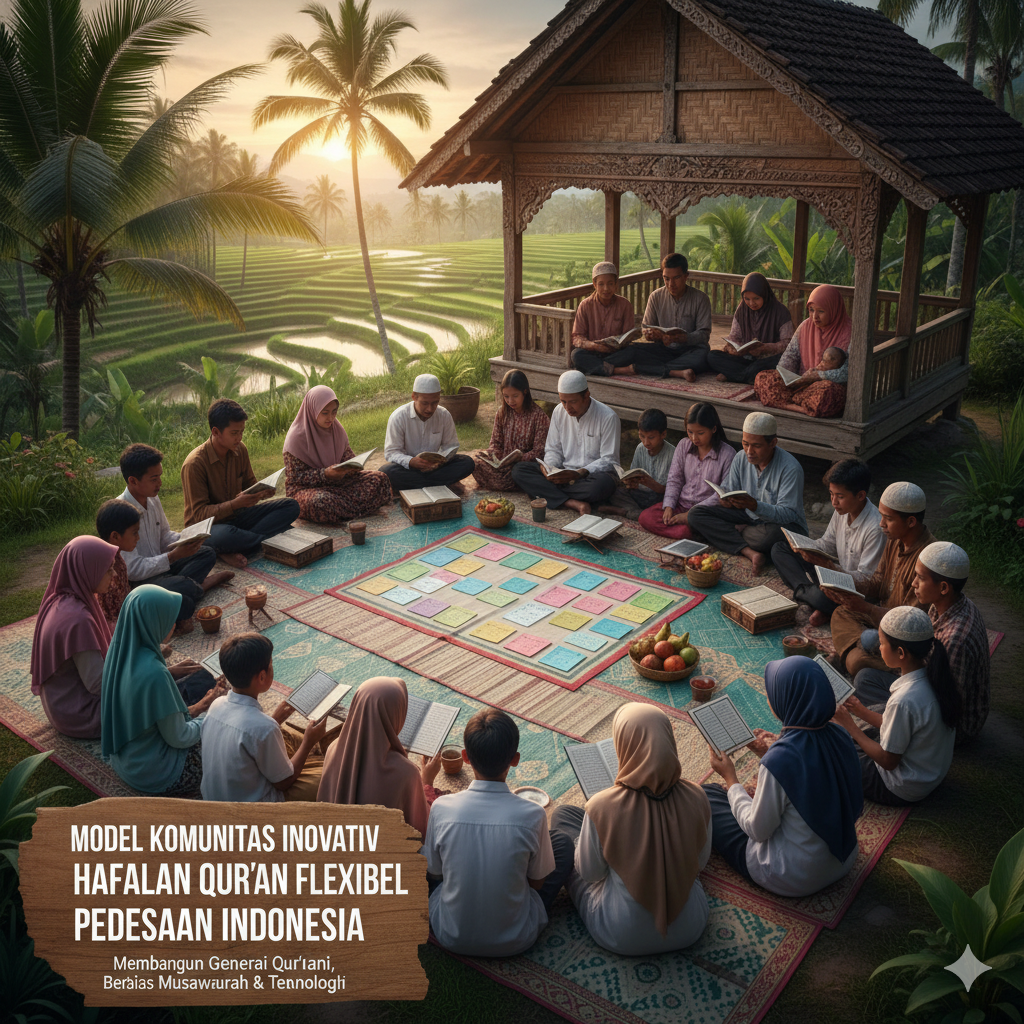
An Innovative Community-Based Model of Flexible Qur’an Memorization in Rural Indonesia
Authors
-
 Rizki Dwi lestari
Universitas Islam Syarifuddin Lumajang, Indonesia
-
Ahmad Hafidz Lubis
Keywords:
Community-based education, Qur’an memorization, flexible learning, nonformal education, rural IndonesiaAbstract
Education extends beyond formal institutions, with non-formal programs playing a key role in skill and character development. This study aims to explore how an innovative, community-based Qur’an memorization program, the “Qur’an Memorization House” in Dusun Legenan, Lumajang, Indonesia, is designed and implemented to foster a genuine love for the Qur’an among young people. Operated by a local mother without a formal curriculum or fees, a qualitative case study was conducted with purposively selected participants, using observation, interviews, and documentation analyzed thematically. Findings indicate that flexible schedules, turn-taking, and peer mentoring enhance participation, motivation, and consistency. The collaborative and socially engaging environment fosters independence, responsibility, and intrinsic motivation, demonstrating that community-driven initiatives can cultivate a love for the Qur’an even with limited resources. This study highlights the potential of adaptive, community-based non-formal education as an effective model for religious learning in rural contexts, providing insights for similar initiatives in comparable settings.
Downloads
References
Andriani, W. R., Rosa, E. M., & Afandi, Moh. (2017). Peningkatan Capaian Kompetensi Kognitif Mahasiswa Akper Pemkab Ponorogo Dengan Penerapan Peer-Assisted Learning (PAL). Indonesian Journal of Nursing Practices, 1(3), 107–114. https://doi.org/10.18196/ijnp.1368
Arfandi, A., Hasanah, H., & Zainuddin, Z. (2023). IMPLEMENTASI METODE TAKRIR UNTUK MEMPERCEPAT MENGHAFAL ALQUR’AN BAGI SISWA DI SEKOLAH DASAR. Edupedia : Jurnal Studi Pendidikan Dan Pedagogi Islam, 8(1). https://doi.org/10.35316/edupedia.v8i1.2935
Aryati, A., Azizah, N., & Hazmin, H. (2020). Pengaruh Hafalan Al-Qur’an terhadap Prestasi Belajar Bahasa Arab Siswa. Journal of Education and Instruction (JOEAI), 3(1). https://doi.org/10.31539/joeai.v3i1.1312
Aziz, N. A. A., Ariffi, N. F. M., Ismail, N. A., & Alias, A. (2023). Community Participation in the Importance of Living Heritage Conservation and Its Relationships with the Community-Based Education Model towards Creating a Sustainable Community in Melaka UNESCO World Heritage Site. Sustainability, 15(3). https://doi.org/10.3390/su15031935
Eneng Sumarni, & Siti Qomariyah. (2023). Peran Metode Kauny Quantum Memory Dalam Pembelajaran Al-Qur’an Untuk Memudahkan Hafalan Al-Qur’an Di Sdit Adzkia 1 Sukabumi. SOKO GURU: Jurnal Ilmu Pendidikan, 3(2). https://doi.org/10.55606/sokoguru.v3i2.2111
Erlina, E., Kurniawan, A. H., Hijriyah, U., & Ismail, M. Z. (2022). The Correlation of Al-Qur’an Memorization and Arabic Learning Achievement. Jurnal Al Bayan: Jurnal Jurusan Pendidikan Bahasa Arab, 14(2). https://doi.org/10.24042/albayan.v14i2.9968
Fadilah, N., Islam, M. H., & Herwati. (2022). Implementasi Metode One Day One Ayat Dalam Meningkatkan Kemampuan Menghafal Al-Qur’an Di Pondok Pesantren. Jurnal Pendidikan Dan Konseling, 4(3).
Haryani, L. D., & Sholeh, M. A. (2019). EFEKTIVITAS METODE TALAQQI DALAM MENINGKATKAN HAFALAN AL-QUR’AN PESERTA DIDIK DI SDIT ULUL AL-BAB WELERI. TA’DIBUNA: Jurnal Pendidikan Agama Islam, 2(2). https://doi.org/10.30659/jpai.2.2.47-52
Hashim, A. (2015). Correlation between strategy of Tahfiz learning styles and students performance in Al-Qur’an memorization (Hifz). Mediterranean Journal of Social Sciences, 6(2S5). https://doi.org/10.5901/mjss.2015.v6n2s5p85
Hidayah, N., Tobroni, T., & Rusady, A. T. (2022). Correlation Between Memory An Qur’an With Student Learning Achievement At Ash-Shohwah Integrated Islamic Junior High School, Berau- East Kalimantan. Edukasi Islami: Jurnal Pendidikan Islam, 11(001).
Hidayat, Y. N. (2025). Peran Pendidikan Agama Islam Dalam Pembentukan Karakter Adaptif Peserta Didik Sekolah Dasar Melalui Konstruktivisme Sosial Vygotsky. Journal Of Educational Research And Community Service (JERCS), 01, 226–233.
Hidayati, Y. (2019). PENGARUH METODE HAFALAN AL-QUR’AN TERHADAP TINGKAT KECERDASAN SPIRITUAL SANTRI DI PONDOK PESANTREN DAARUL-ANBA. THORIQOTUNA: Jurnal Pendidikan Islam, 2(1). https://doi.org/10.47971/tjpi.v2i1.119
Ikhwanuddin, M., & Hashim, C. N. (2014). Relationship between Memorization Technique, Mastery of the Arabic Language and Understanding of the Qur’an. IIUM Journal of Educational Studies, 2(2). https://doi.org/10.31436/ijes.v2i2.46
Irsal, I. L., & Yunita, N. (2022). The Correlation between Memorizing the Qur’an Ability and Students’ Logical-Mathematical Intelligence. Jurnal Pendidikan Matematika (Kudus), 5(2). https://doi.org/10.21043/jpmk.v5i2.16586
Ismail, S., Mustafa, N. M., Shaharuddin, S. A., Yahaya, M., Razali, K. S., & Sapiuddin, U. U. (2023). Pre-School Qur’an Memorization Digital Application Requirements. International Journal of Academic Research in Progressive Education and Development, 12(2). https://doi.org/10.6007/ijarped/v12-i2/18111
Karina, M., Judijanto, L., Rukmini, A., Fauzi, M. S., & Arsyad, M. (2024). Pengaruh Interaksi Sosial Terhadap Prestasi Akademik : Tinjauan Literatur Pada Pembelajaran Kolaboratif. INNOVATIVE: Journal Of Social Science Research, 4(5), 6334–6344.
Lisman, Zainab, K. S., & Wicaksono, H. (2023). Strategi Guru dalam Mengatasi Kejenuhan Belajar Siswa di MTs Al-Maarif Banyorang. Jurnal Al-Qiyam, 3(2). https://doi.org/https://doi.org/10.33648/alqiyam.v3i2.226
M. Asep Fathur Rozi, & Ismah Fakhrunnisa. (2022). Implementasi Program Menghafal Al-Qur’an di Sekolah Dasar Islam Terpadu (SDIT) At-Taqwa Tulungagung. DIMAR: Jurnal Pendidikan Islam, 4(1). https://doi.org/10.58577/dimar.v4i1.70
M, W. R. N. & H. Luqmanul. (2021). Self Manajemen Dalam Meningkatkan Kualitas Menghafal Al-Qur’an. Jurnal Kependidikan Islam, 11.
Mendrofa, Jaya, K., Wau, M., & Waruwu, Y. (2023). Pendidikan Jendela Dunia. Jurnal Visi Pengabdian Kepada Masyarakat, 4(2), 69–77.
Mildawati, T., & Tangngareng, T. (2023). Jenis-Jenis Pendidikan (Formal, Nonformal Dan Informal) Dalam Perspektif Islam. Vifada Journal of Education, 1(2), 01–28. https://doi.org/10.70184/w33a8b87
Mulyani, E., Solihat, A. N., & Hermawan, Y. (2024). Pengaruh Kontunuitas Belajar dan Motivasi Berprestasi Terhadap Hasil Belajar Dengan Dimoderasi Oleh Persistemsi Diri (Survei pada Siswa dalam Mata Pelajaran Ekonomi Kelas X SMA Negeri 1 Cikatomas Tahun Ajaran 2023/2024). Jurnal Sains Student Research, 2(3), 567–579.
Nafisah, S. L., Suharsiwi, S., & Sudin, M. (2023). Teacher Parenting Patterns in Improving Students’ Ability to Memorize Al-Qur’an in Tahfidz Elementary School. Jurnal Obsesi : Jurnal Pendidikan Anak Usia Dini, 7(1). https://doi.org/10.31004/obsesi.v7i1.3645
Nashiratunnisa, N., & Anwar, C. (2023). MANAJEMEN PENDIDIKAN DALAM PERSPEKTIF AL-QUR’AN DAN AS-SUNNAH. BASHA’IR: JURNAL STUDI AL-QUR’AN DAN TAFSIR. https://doi.org/10.47498/bashair.v2i2.1321
Nik Md Saiful Azizi, N. A., Fathiyah Solehah, M. S., & Rabi’atul Athirah, M. I. (2021). Tahfiz students’ experiences in memorizing the Qur’an: Unveiling their motivating factors and challenges. IIUM Journal of Educational Studies, 9(2).
Nurhaliza, F., Hainul Putra, Z., Hermita, N., & Copriady, J. (2025). Reflexive Thematic Analysis sebagai Strategi Kualitatif dalam Kajian Pendidikan Multikultural. INNOVATIVE: Journal Of Social Science Research, 5(3), 5256–5272. https://doi.org/https://doi.org/10.31004/innovative.v5i3.19550
Nurlaila, N. (2020). ANAK-ANAK DAN HAFALAN AL-QURÁN: STUDI METODE MENGHAFAL AL-QURÁN UNTUK ANAK-ANAK. Hikmah: Journal of Islamic Studies, 16(1). https://doi.org/10.47466/hikmah.v16i1.168
Priyoaji, K. S. (2023). Gifted Underachiver: Analisis Self-Determination Theory. Edunomika, 08(01), 2–3. https://doi.org/https://doi.org/10.29040/jie.v8i1.11327
Rachmad, Y. E. (2022). Adaptive Learning Theory. In La Paz Costanera Publicaciones Internacionales. YER E-Book Publication. https://doi.org/https://doi.org/10.17605/osf.io/vfz38
Riska, F. M., Nur, S., Asmara, A., Sa’diyah, Vitalocca, D., Fadjarajani, S., Husnita, L., Shofwan, I., Yusron, A., Arfanaldy, Rd. S. R., Kurdi, M. S., Bantam, D. J., Haryanto, S., Ramadianti, W., Doriza, S., Makmur, E., Muhidin, A., Jayanti, A. M., Kurdi, M. S., & Sampe, F. (2024). Strategi Pembelajaran 5.0. PENERBIT PT MAFY MEDIA LITERASI INDONESIA.
Robani, M. E., Rachim, F. A., Febriani, A., & A, E. R. F. (2021). Metode Learning By Doing Dalam Mengoptilalisasi Kualitas Belajar Siswa Smp. Jurnal Ilmiah Edukasia, 1(1), 24–30. https://doi.org/10.26877/jie.v1i1.7961
Rosyad, S., & Pratisara, G. (2023). Analysis interpersonal communication between Ustadz and Santri in Yaketunis dormitory: Case study of Al-qur’an memorization activities in Yaketunis dormitory. Symposium of Literature, Culture, and Communication (SYLECTION) 2022, 3(1). https://doi.org/10.12928/sylection.v3i1.14053
Sabiq, A. F. (2021). Impelementasi Metode Annida dalam Program Menghafal Al-Qur’an di SD Plus Tahfidzul Qur’an Annida Salatiga. Andragogi: Jurnal Diklat Teknis Pendidikan Dan Keagamaan, 8(2). https://doi.org/10.36052/andragogi.v8i2.164
Safii, A. A., & Anom, L. (2021). Peran Moderasi Financial Access Pada Pengaruh Human Capital Dan Social Capital Terhadap Kinerja UMKM. Jurnal Manajemen Dan Penelitian Akuntansi, 14(1), 36–49. https://doi.org/10.58431/jumpa.v14i1.225
Sari, M. (2021). Peran Orang Tua dalam Memotivasi Anak untuk Mengikuti Pendidikan Tahfiẓ al-Qur’an. Tadabbur: Jurnal Peradaban Islam, 3(2). https://doi.org/10.22373/tadabbur.v3i2.211
Sokib, A., & A’yun, F. N. Q. (2024). Peran Vital Pendidikan Anak dan Dukungan Komunitas dalam Membangun Masa Depan Desa Karanganom. Jurnal Pelayanan Masyarakat, 1(3), 138–145. https://doi.org/10.62951/jpm.v1i3.711
Sugiono, S. (2024). Proses Adopsi Teknologi Generative Artificial Intelligence dalam Dunia Pendidikan: Perspektif Teori Difusi Inovasi. Jurnal Pendidikan Dan Kebudayaan, 9(1), 110–133. https://doi.org/10.24832/jpnk.v9i1.4859
Susanto, R., Widodo, W., & Kolis, N. (2023). The Implication of the Sima’an Ahad Pahing on the Qur’an Memorization at PPTQ Al-Hasan Ponorogo. Al-Adabiya: Jurnal Kebudayaan Dan Keagamaan, 18(2). https://doi.org/10.37680/adabiya.v18i2.2396
Ugur, E., & Osmanoglu, C. (2020). EVALUATION OF QUR’AN MEMORIZATION (HIFZ EDUCATION) TOGETHER WITH FORMAL EDUCATION ACCORDING TO STAKEHOLDERS VIEWS. BILIMNAME, 41(1).
Ummat, L. S., Fahriza, F., & Munir, M. (2024). Pengaruh Motivasi Intrinsik, Kedisiplinan Belajar Dan Lingkungan Belajar Terhadap Hasil Belajar Siswa Di Sma Al Islam Krian. Jurnal Ilmiah Manajemen Dan Bisnis (JIMBis), 3(3), 188–201. https://doi.org/10.24034/jimbis.v3i3.6689
Wintarso, A., Surasman, O., & Saihu, M. (2023). Pengelolaan Pembelajaran Tahfizh Dengan Isyarat Hijaiyah dalam Peningkatan Kemampuan Menghafal al-Qur’an di Pondok Pesantren Tunarungu Darul Ashom Yogyakarta. Jurnal Madani Institute Politik, Hukum, Pendidikan, Sosial Dan Budaya, 12(2).
Published
How to Cite
Conference Proceedings Volume
Section
License
Copyright (c) 2025 Proceeding of the Excellent Campus and Technology Conference

This work is licensed under a Creative Commons Attribution-ShareAlike 4.0 International License.





