
Integrating HR Innovation Capacity and Community Empowerment for Sustainable Heritage Tourism: The Kajoetangan Model from Indonesia
Authors
-
 Endang Sungkawati
Universitas Wisnu Wardana Malang, Indonesia
Keywords:
Technological Innovation, Community Empowerment, Sustainable Tourism, HR ManagementAbstract
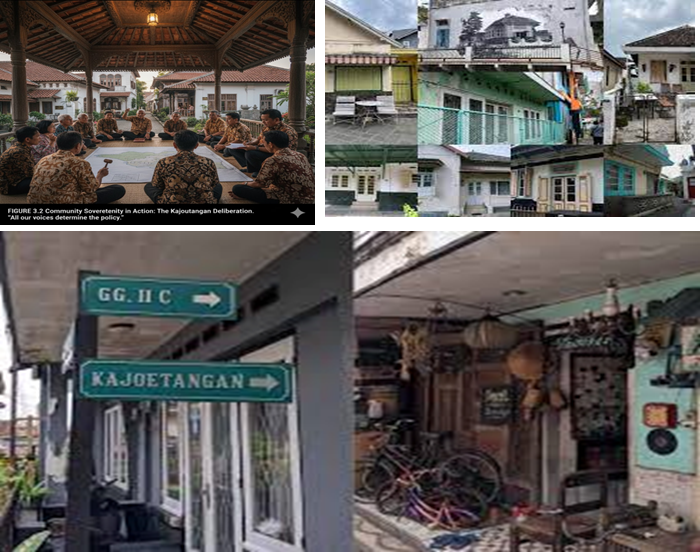
Background: The management of community-based cultural heritage tourism in Indonesia still faces challenges in integrating technological innovation with human and sustainability aspects. Kampung Heritage Kajoetangan in Malang City offers a unique opportunity to explore a sustainable Human Resource (HR) management model. Objective: This study aims to analyze and describe three important pillars in HR management: Innovation Absorption Capacity, Community Empowerment, and their impact on Sustainable Development. Method: A descriptive qualitative method with a case study approach was used to collect data from various sources, including Pokdarwis, neighborhood managers, the City Government, and MSME actors. Results: The findings show that Kampung Kajoetangan has successfully integrated technological innovation through digital skills training, empowered the community through active involvement in decision-making, and implemented environmentally friendly practices. Conclusion: The synergy model between Pokdarwis and local initiatives provides balanced social, economic, and environmental benefits and offers insights that can be adapted by similar tourism destinations in other countries to achieve inclusive and sustainable tourism in the digital era.
Downloads
References
Aisyah, S. (2023). Implications of Planning and Management for the Development of Sustainable Cultural Heritage Tourism in Malaysia. Advances in Tourism Studies, 1(2). https://doi.org/10.47492/ats.v1i2.18
Alazaizeh, M. M., Hallo, J. C., Backman, S. J., Norman, W. C., & Vogel, M. A. (2019). Giving voice to heritage tourists: indicators of quality for a sustainable heritage experience at Petra, Jordan. Journal of Tourism and Cultural Change, 17(3). https://doi.org/10.1080/14766825.2018.1455693
Asmelash, A. G., & Kumar, S. (2019). The structural relationship between tourist satisfaction and sustainable heritage tourism development in Tigrai, Ethiopia. Heliyon, 5(3). https://doi.org/10.1016/j.heliyon.2019.e01335
Aziz, N. A., Muslichah, I., & Ngah, A. H. (2020). Understanding factors influencing community life satisfaction towards sustainable heritage tourism destination: The case of Yogyakarta, Indonesia. Journal of Sustainability Science and Management, 15(1).
Bakhri, S., Fatah, M. I., & Hanum, F. (2021). Analisis Peningkatkan Pendapatan Fee Based Income dengan Penggunaan Aplikasi Mobile Studi Kasus Pada KSPPS BMT UGT Nusantara. Tasharruf: Journal of Islamic Economics and Business, 2, 35–49.
Bakhri, S., Johari, F., & Rahim, H. B. (2023). Productive Waqf Development In Improving Islamic Boarding School Independent Economics. Tasharruf: Journal of Islamic Economics and Business, 1, 1–13.
Bakhri, S., Rofiq, A., & Faizum, D. (2025). Digital Innovation Strategies in Sharia Cooperative Business Transformation: Mobile App Impact on Financial Performance and Member Satisfaction. Revenue Journal: Management and Entrepreneurship, 1, 21–33.
Bili, F. A. (2022). Tinjauan Ekonomi Politik Atas Krisis dan Penelusuran Penyelesaiannya dalam Sejarah. Jurnal Sosial Teknologi, 2(1). https://doi.org/10.36418/jurnalsostech.v2i1.287
Bustomi, A. A. (2019). Kampus Santri: Alternatif Model Sinergi Akulturasi Pendidikan Tinggi Dan Pesantren. Tarbawi: Jurnal Studi Pendidikan Islami, 7(2).
Bustomi, A. A. (2025). Cultural Interactive Media: Elevating Pancasila Learning in Elementary Schools. Applied Observation and Pedagogical Studies Poster, 4(1).
Bustomi, A. A., Khosiah, N., & Fathurrohman, A. (2025). Developing pancasila learning strategies through culture-based interactive media in elementary schools. Assyfa Learning Journal, 1, 43–56.
Chhabra, D. (2009). Proposing a sustainable marketing framework for heritage tourism. Journal of Sustainable Tourism, 17(3). https://doi.org/10.1080/09669580802495758
Donohoe, H. M. (2012). Sustainable heritage tourism marketing and Canada’s rideau canal world heritage site. Journal of Sustainable Tourism, 20(1). https://doi.org/10.1080/09669582.2011.617826
Ghanem, M. M., & Saad, S. K. (2015). Enhancing sustainable heritage tourism in Egypt: Challenges and framework of action. Journal of Heritage Tourism, 10(4). https://doi.org/10.1080/1743873X.2015.1029489
Haddad, N. A., & Fakhoury, L. A. (2016). Towards developing a sustainable heritage tourism and conservation action plan for irbid’s historic core. Archnet-IJAR: International Journal of Architectural Research, 10(3). https://doi.org/10.26687/archnet-ijar.v10i3.1035
Irmawati, I., Mispani, M., Suadi, S., & Amirudin, A. (2024). Teachers in Learning Islamic Religious Education Post the Covid-19 Pandemic at Mutiara Bangsa Elementary School Pringsewu Lampung. Assyfa Journal of Islamic Studies, 2, 107–116.
Kilichov, M., & Serrano Teruel, D. M. (2021). Sustainable Heritage Tourism Development model at heritage resources. Economics and Tourism, 1(1).
Kim, S., Whitford, M., & Arcodia, C. (2019). Development of intangible cultural heritage as a sustainable tourism resource: the intangible cultural heritage practitioners’ perspectives. Journal of Heritage Tourism, 14(5–6). https://doi.org/10.1080/1743873X.2018.1561703
Landorf, C. (2009). Managing for sustainable tourism: A review of six culturalWorld Heritage Sites. In Journal of Sustainable Tourism (Vol. 17, Issue 1). https://doi.org/10.1080/09669580802159719
Li, D., Du, P., & He, H. (2022). Artificial Intelligence-Based Sustainable Development of Smart Heritage Tourism. Wireless Communications and Mobile Computing, 2022. https://doi.org/10.1155/2022/5441170
Li, J., Yang, C., Zhu, Y., & Han, F. (2023). How does the World Heritage Sustainable Tourism Programme guide the evolution of rural landscapes? Landscape Research, 48(4). https://doi.org/10.1080/01426397.2023.2170995
Li, Y., & Hunter, C. (2015). Community involvement for sustainable heritage tourism: a conceptual model. Journal of Cultural Heritage Management and Sustainable Development, 5(3). https://doi.org/10.1108/JCHMSD-08-2014-0027
Lukman, A. (2020). Community-based management of the USAT Liberty, Bali, Indonesia: Pathways to sustainable cultural heritage tourism. Journal of Cultural Heritage Management and Sustainable Development, 10(3). https://doi.org/10.1108/JCHMSD-05-2019-0053
Mensah, J., Tachie, B. Y., & Potakey, H. M. D. (2023). Open defecation near a world heritage site: causes and implication for sustainable tourism and heritage management. Journal of Cultural Heritage Management and Sustainable Development, 13(1). https://doi.org/10.1108/JCHMSD-11-2020-0164
Mohamed Atef, A. (2021). Sustainable Heritage tourism in Egypt. International Journal of Multidisciplinary Studies in Architecture and Cultural Heritage, 4(1). https://doi.org/10.21608/ijmsac.2021.187252
Mzembe, A. N., Koens, K., & Calvi, L. (2023). The institutional antecedents of sustainable development in cultural heritage tourism. In Sustainable Development (Vol. 31, Issue 4). https://doi.org/10.1002/sd.2565
Nihayah, D. M., Fafurida, Kistanti, N. R., & Handaru, A. W. (2020). Assessing visitor preferences as to sustainable heritage tourism. International Journal of Innovation, Creativity and Change, 13(6).
Nursaid, N., Haanurat, A. I., Bakhri, S., & Rahman, A. (2024). Exploring the Shari’ah economic learning model through virtual learning: Initiatives and challenges. Assyfa Journal of Islamic Studies, 2, 141–150.
Peng, C. (2021). Protecting world heritage in China by enacting laws: Sustainable tourism development. Chinese Journal of Population Resources and Environment, 19(1). https://doi.org/10.1016/j.cjpre.2021.12.011
Rohmat, R., Yusuf, M., Fathurrohman, A., & Choirudin, C. (2024). The Influence Of Islamic Parenting Patterns and Parents Religious Understanding On Childrenâ€TMs Spiritual Intelligence In Muslim Families In Metro City. Assyfa Journal of Islamic Studies, 2, 117–126.
Sangchumnong, A., & Kozak, M. (2018). Sustainable cultural heritage tourism at Ban Wangka Village, Thailand. Anatolia, 29(2). https://doi.org/10.1080/13032917.2017.1414435
Sidyawati, L., Sayono, J., Anggriani, S. D., Nurfahrul, M., & Khakim, L. (2021). Pelatihan Pembuatan Dolanan Jadoel dan Infografis Filosofi Dolanan dengan Teknik Batik Kayu. CARADDE: Jurnal Pengabdian Kepada Masyarakat, 4(1).
Stoffle, R., Seowtewa, O., Kays, C., & Van Vlack, K. (2020). Sustainable heritage tourism: Native american preservation recommendations at arches, canyonlands, and hovenweep national parks. Sustainability (Switzerland), 12(23). https://doi.org/10.3390/su12239846
Suadi, S., & Tarwi, M. (2024). Virtual Surveillance: The Role of Housewives in Controlling the Use of Mobile Phones by Early Childhood Children. Proceedings of International Conference on Research and Community Services 3 ….
Sungkawati, E. (2024a). Opportunities and challenges: adopting “blue-green economy†terms to achieve SDGs. Revenue Journal: Management and Entrepreneurship, 1, 1–13.
Sungkawati, E. (2024b). Sustainable Entrepreneurship: Innovative Solutions for Achieving SDGs in Indonesia 2030. Revenue Journal: Management and Entrepreneurship, 2, 182–198.
Sungkawati, E., Safitri, N. D., & Afolaranmi, A. O. (2023). Product life cycle techniques: SMEs maintenance strategies. AMCA Journal of Community Development, 2, 75–84.
Sungkawati, E., & Umali, J. (2024). Blue Carbon and Food Security: A Systematic Review of Mangrove Ecosystem Services for SDG 13 (Climate Action) and SDG 2 (Zero Hunger). Assyfa Journal of Farming and Agriculture, 1, 40–50.
Sungkawati, E., Usmiyatun, U., & Karim, S. (2023). “ Improving” food processing skills by creating new entrepreneurs. Revenue Journal: Management and Entrepreneurship, 1, 76–86.
Sungkawati, E., & Uthman, Y. (2024). Adopting Blue-Green Economy Terms to Achieve SDGs: Indonesiaâ€TMs Opportunities and Challenges. Assyfa Learning Journal.
Syawaludin, M., Fajarudin, A. A., Bahiyyah, K., Fathurrohman, A., & Mukaromah, N. (2025). Efektifitas Upgrading Skill Bahasa Arab di Madrasah Tsanawiyah KHA Wahid Hasyim Bangil. Tarbawi: Jurnal Studi Pendidikan Islami, 1, 1–11.
Tufail, M., Park, J., Kim, H., Kim, S., Kim, K. M., & Lee, J. H. (2022). How do visitors perceive the significance of tangible cultural heritage through a 3D reconstructed immersive visual experience at the Seokguram Grotto, South Korea? Journal of Heritage Tourism, 17(4). https://doi.org/10.1080/1743873X.2022.2039672
Xu, Y., Rollo, J., Jones, D. S., Esteban, Y., Tong, H., & Mu, Q. (2020). Towards sustainable heritage tourism: A space syntax-based analysis method to improve tourists’ spatial cognition in Chinese historic districts. Buildings, 10(2). https://doi.org/10.3390/buildings10020029
Zhao, L., Li, Y., Zhang, N., & Zhang, Z. (2023). Public policies and conservation plans of historic urban landscapes under the sustainable heritage tourism milieu: discussions on the equilibrium model on Kulangsu Island, UNESCO World Heritage site. Built Heritage, 7(1). https://doi.org/10.1186/s43238-023-00086-0
Published
How to Cite
Conference Proceedings Volume
Section
License
Copyright (c) 2025 Proceeding of the Excellent Campus and Technology Conference

This work is licensed under a Creative Commons Attribution-ShareAlike 4.0 International License.





