
The Synergy of NLP Meta-Programming and Gamification in Learning Basic Swimming Skills to Improve Students' Mental Resilience
Authors
-
 Feri Weldani
Universitas PGRI Sumenep, Indonesia
Keywords:
Gamification, Swimming Skills, Students, NLP Meta-ProgrammingAbstract
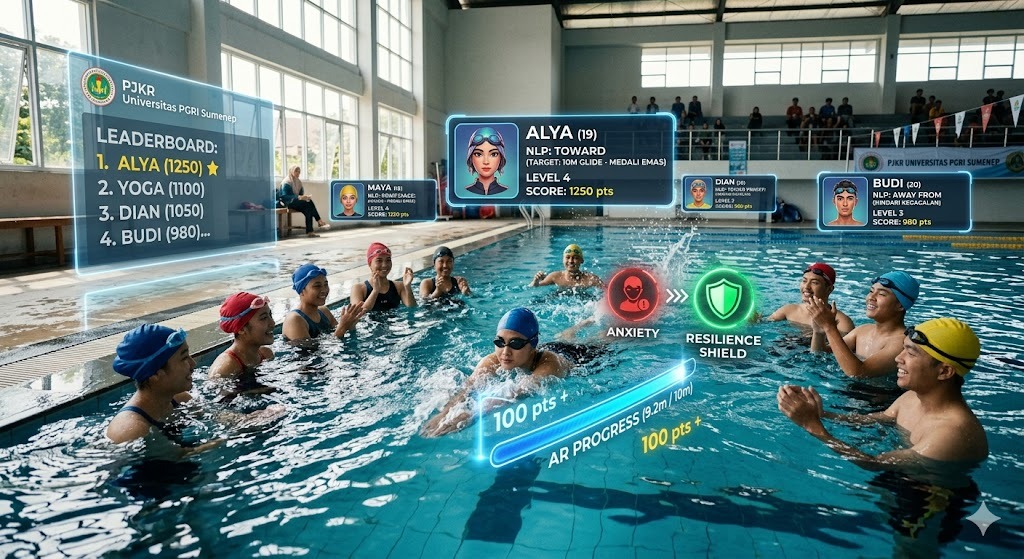
In the current era of digital disruption, physical education students are required to have technological literacy as wellas strong mental resilience to face complex learning challenges. Cognitive and motor adaptation skills are very crucial, where teaching that integrates psychological and technological aspects is seen as the most effective, interesting, and creative strategy. This research is motivated by the phenomenon of high levels of anxiety (sport-anxiety) in students when learning basic swimming skills which often hinders the mastery of motor techniques. So far, research has focused more on conventional physical training methods, but this study evaluates the impact of synergy between psychological aspects of language through Meta-Programming in Neuro-Linguistic Programming (NLP) and technological elements through gamification on the development of mental resilience and psychomotor learning outcomes. The main objective of this study is to analyze the effectiveness of combining NLP mental maps with a point system, challenges, and a digital leaderboard in accelerating the mastery of swimming techniques. The method used is a quasi-experimental with a pretest-posttest control group design, involving PJKR students of PGRI Sumenep University. Data collection was conducted through observations of motor skills and a mobile-based mental resilience scale (digital survey application). The results of the study revealed that this synergy had a significant positive impact; where scaffolding in the form of gamification challenges tailored to the individual's Meta-Program type became a key variable that accelerated anxiety reduction. The findings showed that cognitive variables did not have a direct effect without the reinforcement of motivation from gamification elements. In conclusion, the integration of NLP and gamification technology provides strategic implications for lecturers in creating a more adaptive, inclusive, and resilient aquatic curriculum in the future era of education.
Downloads
References
Almeida-Aguiar, A. S., Betancor León, M. Á., & Espinoza-Gutiérrez, R. (2024). Sport refereeing in the university curricula of Physical Activity and Sports: a comparative study between Spain and Mexico. Cogent Education, 11(1). https://doi.org/10.1080/2331186X.2024.2359873
Avni-Schon, H., & Barat, D. (2010). S.E.L.C - Sportive eLearning centre: Synchronous short-term tailored teaching for low-performing students. 9th European Conference on ELearning 2010, ECEL 2010, 39–48. https://www.scopus.com/pages/publications/84901976159?origin=resultslist
Castro, J., & Morgan, K. (2025). Critical application of TGfU in sports coaching. Physical Education and Sport Pedagogy. https://doi.org/10.1080/17408989.2024.2446780
Cook, P. (2025). There is more to life than sport: Debating popular culture to develop critical thinking skills. Journal of Hospitality, Leisure, Sport and Tourism Education, 36. https://doi.org/10.1016/j.jhlste.2025.100537
Dorokhov, S. I., & Dergachev, V. B. (2020). INFLUENCE OF SPORTS ON STUDENT LIFE. Russian Military Medical Academy Reports, 39(2S), 93–95. https://doi.org/10.17816/rmmar43218
Dutta, S. (2026). The measurement of time and the management of sport: a study of vernacular didactic literature for children in mid-nineteenth-century Bengal. South Asian History and Culture, 17(2), 170–192. https://doi.org/10.1080/19472498.2025.2602348
Fredericks, J. J. (2025). Teaching Sport History as a Public Service Critical Pedagogies and Public Sport Histories. Journal of Sport History, 52(3), 54–68. https://doi.org/10.5406/21558450.52.3.06
Hoven, M. (2022). ‘A Powerful Sporting Tradition among Canadian Basilians’: Early Twentieth-Century Catholic Priest-Coaches at St Michael’s College. International Journal of the History of Sport, 39(4), 366–384. https://doi.org/10.1080/09523367.2022.2066079
Kretschmann, R. (2009). “One day i will manage FC bayern Munich!” - How sport management games train prospective sport managers, development of competencies by playing digital sports games?! In M. Pivec (Ed.), Proceedings of the European Conference on Games-based Learning (Vols. 2009-January, pp. 234–241). Dechema e.V. https://www.scopus.com/pages/publications/84938601363?origin=resultslist
Light, R., & Dixon, M. A. (2007). Contemporary Developments in Sport Pedagogy and their Implications for Sport Management Education. Sport Management Review, 10(2), 159–175. https://doi.org/10.1016/S1441-3523(07)70009-8
Magdalinski, T. (2013). Study skills for sports studies. In Study Skills for Sports Studies. Taylor and Francis. https://doi.org/10.4324/9780203113974
Matheson, V. A., & Fenn, A. J. (2022). Teaching Sports Economics and Using Sports to Teach Economics. In Teaching Sports Economics and Using Sports to Teach Economics. Edward Elgar Publishing Ltd. https://doi.org/10.4337/9781800884182
Morgan, H., & Parker, A. (2022). Sport, physical activity and criminal justice: Politics, policy and practice. In Sport, Physical Activity and Criminal Justice: Politics, Policy and Practice. Taylor and Francis. https://doi.org/10.4324/9781003207788
Nols, T., Ulfert, A.-S., & Gevers, J. (2026). Human-autonomy-teaming in e-sports: An exploratory study. Computers in Human Behavior Reports, 21. https://doi.org/10.1016/j.chbr.2025.100919
Park, S., & Kim, Y. (2024). Leveraging Educational Technology in Liberal Arts Dance Sports: Exploring Effectiveness and Sustainable Application. Sustainability (Switzerland), 16(19). https://doi.org/10.3390/su16198491
Parker, A., & Vinson, D. (2013). Youth sport, physical activity and play: Policy, intervention and participation. In Youth Sport, Physical Activity and Play: Policy, Intervention and Participation. Taylor and Francis. https://doi.org/10.4324/9780203147436
Platania, F., Toscano Hernandez, C., & Appio, F. P. (2026). Beyond the game: Leveraging athlete celebrities for value creation in sportswear brands in the digital era. European Management Review. https://doi.org/10.1111/emre.70064
Ponciano Núñez, P. D. (2025). Sport, consciousness, and epistemic justice: a critical model for decolonising sport-for-development in the Global South. Third World Quarterly, 46(17), 2371–2387. https://doi.org/10.1080/01436597.2025.2552350
Priyadarshini, U., Jonjua, M., Singh, S. K., & Mishra, P. (2026). Artificial Intelligence in Paralympic Sports: Advancing Training, Performance, and Media Representation. Macromolecular Symposia, 415(1). https://doi.org/10.1002/masy.70171
Raven, S. (2018). Mind the gap: Sport management education and employability auto-ethnographical analysis of sport management education and the sports fitness industry. Education and Training, 60(5), 458–472. https://doi.org/10.1108/ET-11-2017-0179
Sattler, L. A., & Warren, C. (2016). Exploring student perceptions of sales: A case study of a sport-sales course. Sport Management Education Journal, 10(2), 93–102. https://doi.org/10.1123/smej.2015-0014
Scott, J., & Cano, S. (2025). Sports in principles of economics textbooks. Managerial Finance, 51(7), 1049–1065. https://doi.org/10.1108/MF-06-2024-0471
Smith, G. (2012). The sporting life. Taiwan Review, 62(1). https://www.scopus.com/pages/publications/84862920295?origin=resultslist
Tang, C., Yi, W., Zhang, Z., Occhipinti, E., & Occhipinti, L. G. (2026). AI-Driven Smart Sportswear for Real-Time Fitness Monitoring Using Textile Strain Sensors. IEEE Transactions on Biomedical Engineering, 73(2), 555–565. https://doi.org/10.1109/TBME.2025.3588051
Verma, J. P. (2016). Sports research with analytical solution using SPSS. In Sports Research with Analytical Solution using SPSS. wiley. https://www.scopus.com/pages/publications/105006570346?origin=resultslist
White, J. B., Parker, A., & Meyer, A. R. (2023). Challenging the Integration of Youth, Faith, and Sports: Alternative Religious Beliefs and Assumptions. Religions, 14(9). https://doi.org/10.3390/rel14091171
Yang, Z., Dai, J., Zhang, J., & Yang, Z. (2026). SPORTS: Simultaneous Panoptic Odometry, Rendering, Tracking and Segmentation for Urban Scenes Understanding. IEEE Transactions on Multimedia. https://doi.org/10.1109/TMM.2026.3654342
Zervas, K., & Glazzard, J. (2018). Sport management student as producer: embedding critical management studies in sport through contemporary pedagogy. Sport, Education and Society, 23(9), 928–937. https://doi.org/10.1080/13573322.2016.1276052
Zhou, X., Dai, F., Li, B., & Chen, Y. (2025). Design and Application Research of Intangible Cultural Heritage Sports Projects Enabled by Digital Intelligence Empowered Sports Tourism APP. Proceedings of 2025 International Conference on AI-Enabled Education, AIEE 2025, 43–47. https://doi.org/10.1145/3768421.3768429
Published
How to Cite
Conference Proceedings Volume
Section
License
Copyright (c) 2024 Proceeding of the Excellent Campus and Technology Conference

This work is licensed under a Creative Commons Attribution-ShareAlike 4.0 International License.





