
Inclusiveness in the Development of Islamic Religious Education Curriculum Based on Psychology: A Framework for Sustainable Humanity and Digital Adaptation
Authors
-
 Nurul Mawaridah
SMP Negeri 4 Pasuruan, Indonesia
Nurul Mawaridah
SMP Negeri 4 Pasuruan, Indonesia
Keywords:
Inclusivistic, curriculum development, psychology, SustainabilityAbstract
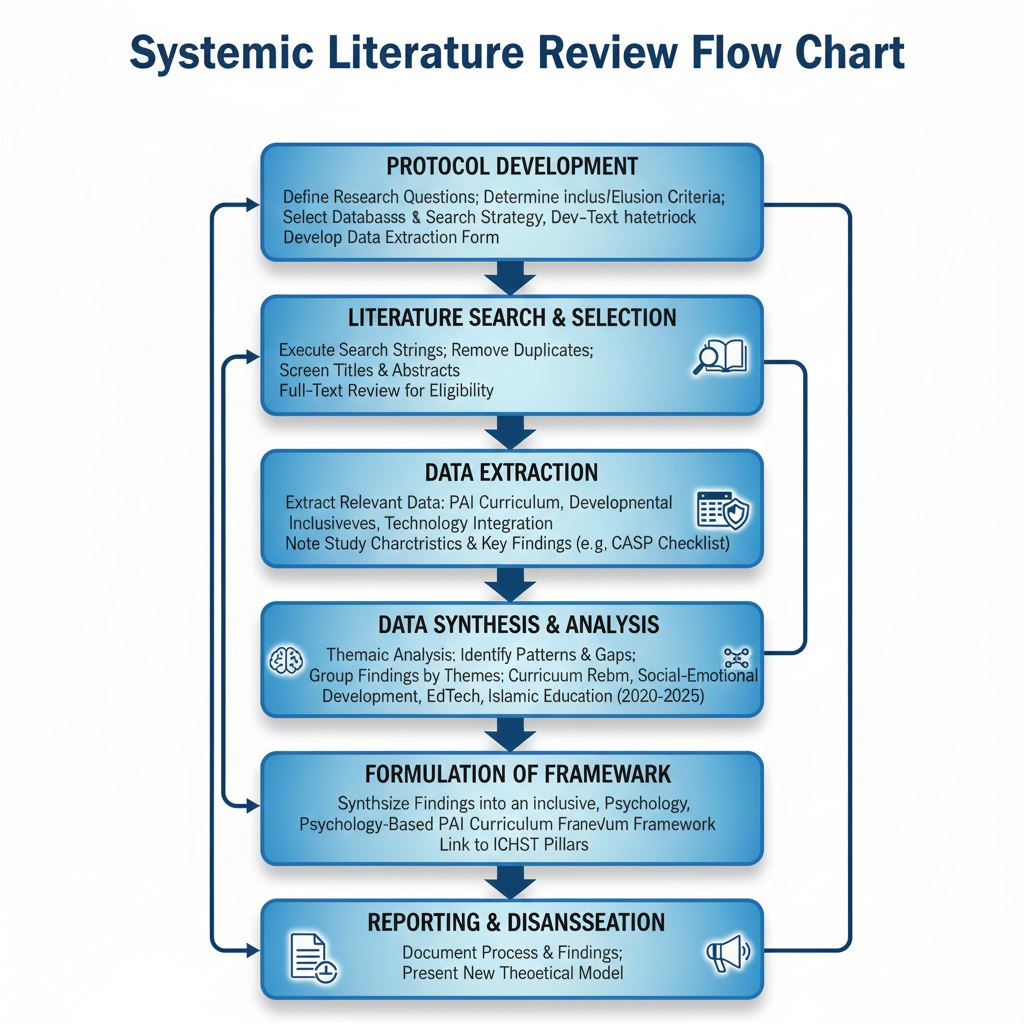
Islamic Religious Education (IRE) learning at the elementary and secondary levels often faces methodological stagnation, marked by an unengaging, uninnovative learning process that is considered weak in moral inculcation. Background: This phenomenon necessitates significant curriculum reform to address national educational challenges. Objective: This study aims to present the fundamental concept of inclusiveness and a sustainable framework for psychology-based IRE curriculum development, explicitly linking it to the three conference pillars: Humanity, long-term Sustainability, and digital adaptation (Technology). Method: This qualitative research employs a Systematic Literature Review (SLR). Results: The findings indicate that inclusiveness in the IRE curriculum is an Islamic education that acknowledges and respects student diversity and plurality, essential for achieving social harmony and educational equity. The proposed framework emphasizes developmental psychology to cultivate robust inclusive attitudes, capable of facing the challenges of the digital age, and ultimately supporting the creation of a cohesive and sustainable society. Conclusion: The development of a psychology-based, inclusive IRE curriculum is an urgent endeavor that, when strategically aligned with Sustainability and Technology, will create a cohesive, ethical, and resilient society in the digital era.
Downloads
References
Ahlstrom-Vij, K. (2023). Do We Live in a ‘Post-Truth’ Era? Political Studies, 71(2). https://doi.org/10.1177/00323217211026427
Aminudin, A. (2022). Menghadapi Disinformasi Konten Berita Digital di Era Post Truth. JURNAL LENSA MUTIARA KOMUNIKASI, 6(2). https://doi.org/10.51544/jlmk.v6i2.3137
Arnus, S. H., Husain, W., & Asriani, D. (2023). Online Media Literacy among Gen Z in Kendari City in the Post Truth Era. KOMUNIKA: Jurnal Dakwah Dan Komunikasi, 17(1). https://doi.org/10.24090/komunika.v17i1.7806
Budgeon, S. (2021). Making feminist claims in the post-truth era: the authority of personal experience. Feminist Theory, 22(2). https://doi.org/10.1177/1464700120988638
Bustomi, A. (2024). The Relationship Between Islamic Law and Positive Law of Indonesia and Recht Customs. Jurnal Legisci, 2(1), 91–101.
Bustomi, A. A. (2016). Prospektif Pesantren sebagai lembaga Pendidikan dalam Konstruksi Multikultural Masyarakat Indonesia. Dirasat: Jurnal Manajemen Dan Pendidikan Islam, 2(1), 132–145.
Bustomi, A. A. (2019a). Kampus Santri: Alternatif Model Sinergi Akulturasi Pendidikan Tinggi Dan Pesantren. Tarbawi: Jurnal Studi Pendidikan Islami, 7(2).
Bustomi, A. A. (2019b). Kampus Santri: Alternatif Model Sinergi Akulturasi Pendidikan Tinggi Dan Pesantren. Tarbawi: Jurnal Studi Pendidikan Islami, 2.
Bustomi, A. A. (2020). Reaktivasi paradigma Islam wasathiyah masyarakat kampus melalui sinergi potensial pendidikan tinggi &pesantren. AL-IFKAR, 14(2), 47–63.
Bustomi, A. A. (2024). Penerapan model komunikasi partisipatif dalam pengembangan program pendidikan anak usia dini berbasis pesantren. Jurnal Penelitian Tindakan Kelas, 2(2), 121–138.
Ceyhan, G. D., & Saribas, D. (2022). Research trends on climate communication in the post-truth era. Educational and Developmental Psychologist, 39(1). https://doi.org/10.1080/20590776.2021.2001295
Chair, B. M., & Adzfar, Z. (2021). Kebenaran di Era Post-Truth dan Dampaknya bagi Keilmuan Akidah. FIKRAH, 9(2). https://doi.org/10.21043/fikrah.v9i2.12596
Davids, N. (2021). Academic freedom and the fallacy of a post-truth era. Educational Philosophy and Theory, 53(11). https://doi.org/10.1080/00131857.2021.1917363
Erturk Kilic, B. (2023). Program development for leaders in the post-truth era: Arts-based creative leadership communication program. Evaluation and Program Planning, 98. https://doi.org/10.1016/j.evalprogplan.2023.102295
Faturahmi, N. I. (2020). Peran lembaga informasi dalam era post-truth. Berkala Ilmu Perpustakaan Dan Informasi, 16(2). https://doi.org/10.22146/bip.v16i2.101
Frederick, D. E. (2021). Scientific literacy, librarians and information literacy in the post-truth era. Library Hi Tech News, 38(9). https://doi.org/10.1108/LHTN-04-2021-111
Hadijah Arnus, S., Husain, W., & Asriani, D. (2023). This is an open accessed articel under the CC-BY-SA license at https://creativecommons.org/licenses/by-sa/4.0/ Online Media Literacy among Gen Z in Kendari City in the Post Truth Era. Jurnal Dakwah Dan Komunikasi, 17(1).
Hainscho, T. (2023). Calling the news fake: The underlying claims about truth in the post-truth era. Philosophy and Social Criticism, 49(7). https://doi.org/10.1177/01914537211066854
Harambam, J., Grusauskaite, K., & de Wildt, L. (2022). Poly-truth, or the limits of pluralism: Popular debates on conspiracy theories in a post-truth era. Public Understanding of Science, 31(6). https://doi.org/10.1177/09636625221092145
Howat, A., Bruschke, J., & Ocampo, M. (2023). Critical thinking instruction for the post-truth era. Argumentation and Advocacy, 59(1–4). https://doi.org/10.1080/10511431.2022.2125698
Huda, M. S., & Irama, Y. (2021). Resiliensi Muslim Moderat di Era Post Truth: Tipologi, Teori dan Praktik Di Indonesia. El-Buhuth: Borneo Journal of Islamic Studies. https://doi.org/10.21093/el-buhuth.v3i2.3558
Ikhsan, M., . A., Fithriani, R., Habibi, A., Ridwan, M., Rusydi, I., A. Sipahutar, A., & Suhardi, B. (2021). Digital Literacy in the Post-Truth Era: Employing Fact-Checking Applications in Adult EFL Reading Classes. KnE Social Sciences. https://doi.org/10.18502/kss.v5i4.8704
Li, W. (2023). The Influence of Social Media Sentiment on Online Public Opinion in the Post-truth Era. Journal of Education, Humanities and Social Sciences, 8. https://doi.org/10.54097/ehss.v8i.4395
Ljungblad, A. L. (2023). greta thunberg — a unique voice in a post-truth era. Childhood and Philosophy, 19. https://doi.org/10.12957/CHILDPHILO.2023.69835
Moravcikova, E. (2020). Media Manipulation And Propaganda In The Post-Truth Era. MEDIA LITERACY AND ACADEMIC RESEARCH, 3(2).
Nash, B. L. (2021). Constructing Meaning Online: Teaching Critical Reading in a Post-Truth Era. Reading Teacher, 74(6). https://doi.org/10.1002/trtr.1980
Nasikhin, & Mahfud Junaedi. (2022). Strategies For Delivering Islamic Religious Education Learning Materials in The Post-Truth Era. NUANSA: Jurnal Penelitian Ilmu Sosial Dan Keagamaan Islam, 19(2). https://doi.org/10.19105/nuansa.v19i2.6354
Naskah, R., & Febrian Korompis, B. (2023). Reformasi dan Hermeneutika di Era Post Truth. Prosiding International Reformation Conference, 1(1).
Pardede, J. N., & Poluakan, P. H. (2021). Law and Post-Truth: Critical Constructivism as an Ideal Legal Reasoning Method on Indonesia’s Post-Truth Era Society. Volksgeist: Jurnal Ilmu Hukum Dan Konstitusi, 4(1). https://doi.org/10.24090/volksgeist.v4i1.4202
Parker, L., & Smith, K. (2022). Literacy Education in the Post-Truth Era: The Pedagogical Potential of Multiliteracies. Language and Literacy, 24(2). https://doi.org/10.20360/langandlit29577
Prasanti, D. (2020). Internalisasi Nilai Islam di era Post-truth: Instagram dr@zaidulakbar sebagai Media Literasi Informasi Kesehatan. Al-Izzah: Jurnal Hasil-Hasil Penelitian. https://doi.org/10.31332/ai.v0i0.1790
Ruslan, R. (2022). Critical Information Literacy in the Post-Truth Era: A Strategy for Facing Information Flow in Indonesia. Jurnal Adabiya, 24(1). https://doi.org/10.22373/adabiya.v24i1.12325
Salganova, E. I., Bredikhin, S. S., & Shchetinina, E. V. (2023). Media and Information Literacy of Young Students in the Post-Truth Era. Galactica Media: Journal of Media Studies, 5(3). https://doi.org/10.46539/gmd.v5i3.342
Saliu, H. (2022). PUBLIC DIPLOMACY OR PUBLIC GLOCALIZATION? RETHINKING PUBLIC DIPLOMACY IN THE POST-TRUTH ERA. Vestnik Moskovskogo Universiteta. Seriya 10. Zhurnalistika, 2022(1). https://doi.org/10.2139/ssrn.4147819
Sel, B. (2022). Social media use of prospective teachers in the post-truth era: Confirmation, trust, critical thinking tendency. Participatory Educational Research, 9(2). https://doi.org/10.17275/per.22.49.9.2
Toivanen, P., Nelimarkka, M., & Valaskivi, K. (2022). Remediation in the hybrid media environment: Understanding countermedia in context. New Media and Society, 24(9). https://doi.org/10.1177/1461444821992701
Visvizi, A., Jussila, J., Lytras, M. D., & Ijäs, M. (2020). Tweeting and mining OECD-related microcontent in the post-truth era: A cloud-based app. Computers in Human Behavior, 107. https://doi.org/10.1016/j.chb.2019.03.022
Xiu, L., Yang, Y., Han, T., & Yu, G. (2020). Emotional expression inhibits attention bias: From the post-truth era perspective. Social Behavior and Personality, 48(4). https://doi.org/10.2224/sbp.8961
Published
How to Cite
Conference Proceedings Volume
Section
License
Copyright (c) 2025 Proceeding of the Excellent Campus and Technology Conference

This work is licensed under a Creative Commons Attribution-ShareAlike 4.0 International License.





